Long Range Planning: Puppets for Peace

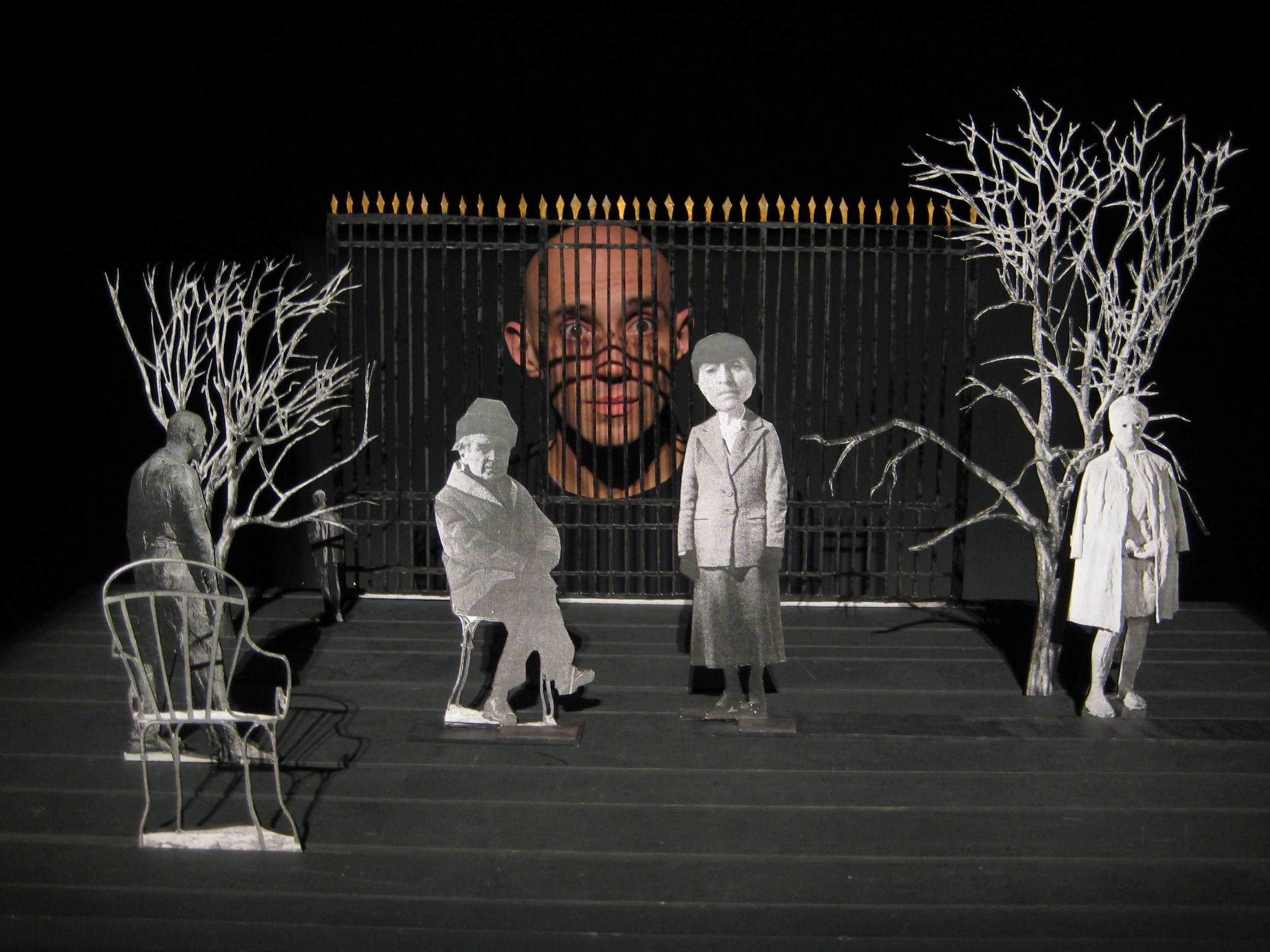
A Tarumba - Teatro de Marioneta from their production This is not Gogol’s Nose. A Tarumba performed and taught toy theater workshops at pop-up puppets in stockholm, sweden.

A Tarumba - Teatro de Marioneta from their production This is not Gogol’s Nose. A Tarumba performed and taught toy theater workshops at pop-up puppets in stockholm, sweden.

by Kathy Foley

Geoffrey Cormier asked me to blog on Long Range Planning for UNIMA-USA.  I went for a walk in the meadow and thought, "Okay, what is the plan?"  And then I thought, "World Peace."  I thought about this especially because of the world we live in now. With the distance between manipulator and the manipulated on the Internet, we are seeing an increased space between crafter and the creation, which is sometimes ugly.

Of course non-puppet people think that is what puppetry is about—hiding behind and pulling strings. But anyone who has been above or under an actual puppet knows that what you can do with the figure is already implicit in its make-up. We are attached to our object and in it—one thing with it. One of the beauties of puppetry is that it can range from very small (think toy theatre) to very big (think King Kong on Broadway). What is great about UNIMA is it puts us, through festivals, commissions, and publications, in contact with others who understand that connection of made environment and self and, like us, use objects to explore important stories. We are puppet people.

We live in a world which needs more empathy and hearing across national and international divides. UNIMA-International next spring will hold its 90th anniversary with performances of stories of friendships through puppetry that crossed "enemy lines" in WWII. These are stories about peace with others and our world. 

I spent my summer seeing our common concerns first in Asia and then in Europe. I was invited to speak at first the International Conference on Islamic Thought and Culture in Perak, Malaysia. I reminded the speakers gathered from across the Muslim world as we talked about curbing terrorism, using religion as a force for good, and creating a just social order that puppetry is one of the deep historical arts of the Islamic world from Karagoz (created we are told by the dervish Seh Kusteri) to the Indonesian saint and puppet master Sunan Kalijaga. Object theatre is to share visions of goodness and justice.

Soon thereafter, I was speaking in Sweden for a seminar at Pop-up Puppets at the Marionetteatern's 60th anniversary in Stockholm where Punch, Pulchinella, Pochinelle, and Dom Gil performers had gathered from across Europe to perform alongside troupes that were creating new work to respond to the migrations and rise of xenophobia in Europe from the immigrations due to the crisis in the Middle East. I reminded the seminar that the comic clown associated with traditional European puppetry has iconography and that swazzle voice that may trace back to north India and the interrelationship of "gypsies" (i.e. migrating groups) and those puppet traditions can be pointed out historically. Most of our great puppet clowns are at least cousins. We may not have DNA kits for figures—but we can trace the path of first mentions (often in police records complaining of the puppeteer-acrobats-dancers-musicians-tooth pullers that pull into town).

Among the artists who were co-presenting were NY puppeteer Roman Paska who I had first met on a puppet stage one night in Indonesia. Also there was the head of UNIMA-International Dadi Pudumjee whose Ishara Puppet Trust welcomes puppeteers from all over the world to perform each spring. Dadi had studied in Sweden in the 1970s with  Michael Meschke who founded the Marionetteatern in 1958 (Meschke was himself a Jewish refugee from Nazi anti-semitism). Meschke long had collaboration with Asia and he helped popularize Bunraku style manipulation now so popular in the west. Meschke's early Ubu Roi which mixed puppets, body puppets, and avant-garde imagery was part of the display we saw in the newly opened performing arts museum—his reaction to the propaganda of WWII and the early Cold War. Meschke made peace with puppets--doing workshops in India, Thailand and beyond. He was one of the ones who put UNIMA back together again after WWII. Helena Nilsson, current head of the company, and Margareta Sorenson, who put together the seminar, were carrying on Meschke's vision: peace via puppets. Use art to talk about connections, to greet refugees, and to help solve misunderstandings.

When Jim Henson went for a walk on a British heath while brainstorming about an internationally syndication-potential TV show with puppets, he had a brainstorm: "World Peace," he suggested, should be the nub of the show. It became Fraggle Rock. Henson who was founding president of UNIMA-USA was also propelling us toward peace in founding our organization. We make puppets, not war.

We recently sent our greetings to UNIMA-Russia on their 60th year (see Kurt Hunter’s video of congratulations). We look forward to our Prague Spring in 2019 when UNIMA-International will toast its 90th year. We are an organization that crosses time-zones, borders, oceans. The marionettists and the Robotics nerds are friends. Our long-range plan is a just, equitable, and peaceful world where we and the material world—our puppets—are in sync. The puppeteer and the object must always be one for the show to go successfully on.   

Puppetry International Online: A Note for Members from Andrew Periale

PI#44-Cover.jpg

If Issue #44 of Puppetry International has not arrived in your mailbox yet, it will soon. As an UNIMA-USA Member, though, you can enjoy it right now on your laptop, tablet, smartphone or any other device you use to link to the internet. Just go to the Current Member Portal. Once you log in with your current Member password, you can read the entire magazine. This is the "Puppetry and Social Justice" issue and it is full of compelling stories about people who are working to make a difference, and, of course, lots of amazing puppets! Happy reading!

--Andrew Periale, Editor of Puppetry International Magazine

Read more about issue #44 in our Puppetry International Index. You can purchase copies in our online store.

Speaking Spoof to Power

by Donald Devet  

Donald Devet

Donald Devet

For the past year and a half Bob Nathanson of Puppets To Go and I have produced movie posters satirizing the current political climate here in the USA. His comedic sense and my computer skills have proven a fruitful combination. We’ve produced over 450 posters and continue to feature a new poster five days a week. Bob is an active touring puppeteer whereas I morphed my puppetry skills into video and graphic production in 1999. Our method of speaking truth to power is meant to evoke a reaction: a laugh, a knowing nod, or sometimes, disgust.

Our puppetry experiences have paid off for Bob and me in the creation of our posters. Years of writing and performing shows have honed our abilities to zero in on a topic and deliver a powerful message. Even though we are no experts in political puppetry, we are motivated by the shifts in political ideology to put our skills to work in calling out political perversity. We follow in a great tradition, for wherever there is political disorder puppets have been drafted into service as voices of dissent. For a detailed overview of puppets used in time of oppression, read K. Ruby and Morgan Andrews’ “History of Radical Puppetry.” Another good political puppetry resource is the website Puppetry Films. Six short videos demonstrate puppets used in protest in South Africa, Kenya, and the USA.

Maybe you are toying with the idea of using your puppetry skills for political purposes. We encourage you to do so. You don’t have to take to the streets with oversized caricatures to communicate. Political messages can be weaved into your current repertoire. For instance, when I was performing with Drew Allison of Grey Seal Puppets, we satirized Richard Nixon in our adaptation of The Emperor’s New Clothes. The emperor’s line, “There are no bugs in the palace,” drew knowing chuckles from adults in the audience. We also produced an adaptation of Orwell’s Animal Farm, an allegorical novella written in 1941, reflecting events leading from revolution to tyranny that rings even truer today.

More recently, I produced a 53-episode web series satirizing the 2016 election. A puppet “Harold” discovers the rough and tumble world of American politics as he runs for President. My experiences producing the “Harold and Me” series is featured in the 2016 fall issue of Puppetry Journal.

Whether your political puppetry takes the form of a live show, a video or even a poster, you’ll be joining a long line of puppeteers using puppets to challenge authority.

Other Links:

The Puppet and the Power

Trumped Up Flicks

Visiting Asia

by Kathy Foley 

In June and July, I traveled through Korea, Malaysia, and Indonesia. While I was there, I had the chance to interact with various groups of puppeteers and theatre people. In Korea with Matthew Cohen (Royal Holloway University of London) and Song Jungmin, we went to the Asian Cultural Center in Kwanju where we learned of the artistic residencies and research opportunities that the center provides for anyone doing research on the Asia-Pacific region. We saw the artist studios and learned of the residencies they offer. Anyone doing research or creative work that has to do with Asia should consider it. Cohen presented on his work on wayang and I presented on how one can approach exhibiting puppetry by trying to recreate the liveness of puppetry in the still environment of a museum, citing the recent exhibit Indian Puppets: The Great Stories and Dancing Dolls at the Center for Puppetry Arts.

Asian Cultural Center facilities for residencies and research in Kwanju (photo via ACC website)

Asian Cultural Center facilities for residencies and research in Kwanju (photo via ACC website)

In Seoul, I was able to meet with members of UNIMA-Korea and explore the idea of doing an exhibit that might include Korean Masks and puppets.   Artstage San which brought Dallae's Story, about a young Korean Girl caught in the Korean war, is one of the largest companies and has a repertoire that ranges from Western fairy tales, to Shakespeare, to tales of orphan David Misang McKenzie, a Canadian-Korean adoptee who goes to South Korea looking for his roots. The latter was a co-production with a Canadian company and based on a true story. Theatre Ro Gi Narae, led by Bae Geunyong, did a lovely production at Jongno Children's Theatre about the michevious Korean dokkaebi trickster spirits of Korean folklore who interacted with a contemporary Korean boy.

A small puppet festival in Seoul ranged from solo avant-garde pieces to an elaborate children's show with live pungmul (Korean drumming). From Theatre Company SaniNeomeo, I learned of their production of Park Chumji Returns which reprises traditional puppetry (with Punch-and-Judy-like action) using larger puppets and more manipulators, while interpreting the work for contemporary audiences. A new president of UNIMA-Korea received me as the last president had just been elected mayor of Chuncheon, which appropriately holds the country's largest puppet festival every Fall and always welcomes foreign companies to its lineup.

Sunan Kalijaga.jpg

In Ipoh, Malaysia, I was a speaker at the Fifth World Conference on Islamic Thought and Culture, presenting on the intertwined history of puppetry and Islam in Southeast Asia. I told the stories of the fifteenth century Islamic Saints who converted Java to Islam using puppet shows, music, and female performance.

The image to the left is Sunan Kalijaga - the most famous of these fifteenth century saints - and who is credited with inventing the shadow show (wayang kulit purwa) among many other artistic endeavors.  I remarked on the irony that puppeteers who consider themselves as the descendants or students of such saints are being banned from performing in their home state of Kelantan in Malaysia and discussed the plight of puppeteers in Southern Thailand who find that the current strife between the state police and Islamic fundamentalist is making it hard for nang talung, the puppet art of Southern Thailand, to persist, even as it is being converted into a dance drama form at the local school of performing arts in Nakorn Sri Thammarat.

Students rehearse the opening of a dance drama based on nang talung shadow puppets in Nakorn Sri Thammarat. (Photo: Kathy Foley)

Students rehearse the opening of a dance drama based on nang talung shadow puppets in Nakorn Sri Thammarat. (Photo: Kathy Foley)

In Indonesia, I had the honor of seeing the final projects of the dalang puppeteers class at Institut Seni Indonesia (Indonesian Institute of the Arts) led by I Nyoman Sedana who has written on his own cross cultural adaptations for  Issue #38 of Puppetry International. Student work ranged from marionette adaptations to pop-up book scenery to traditional shadow work. Young energy and creativity were rampant as young dalangs took on issues of land grabs for resort or business that disenfranchises villagers. Their teachers encouraged them to know tradition but explore the new.

It was cremation season so I also saw a performance of the story of how Bima goes to release his parents' souls from hell (a necessary part of any cremation ritual), performed by a young puppeteer mourning his own father in the rites. Understanding the context and personal engagement gave the viewing additional meaning as the Burly Bima opened the gates of hell.

The puppeteers in Denpasar spoke with anticipation of the April 2020 World Puppetry Festival that will be held in Gianyar. They invited UNIMA-USA members to come and learn of the deep cultural meanings and the modern permutations they are taking with wayang.

The Citations of Excellence in the Art of Puppetry

UNIMA-USA Citations of excellence certificate artwork by Brad Williams

UNIMA-USA Citations of excellence certificate artwork by Brad Williams


By Steven Widerman 

The Citations of Excellence in the Art of Puppetry (nicknamed the “UNI”) are precisely what their name states, a work that has been cited as excellent. Perhaps more importantly, it is not a competitive award, there are no categories other than live and recorded media, and there is no requirement that there be a recipient in any award-year. There is also no cap on the number of recipients in any award-year. This structure has proven both equitable and durable, and we have to thank Jim Henson for proposing his idea for the awards in 1973. In a letter written to Allelu Kurten, who was General Secretary of UNIMA-USA at the time, Henson wrote:

  . . . when you sit around talking with someone who knows Puppetry, and someone whose opinion you trust, and that person says ‘I just saw a terrific show that I strongly recommend,’ then you sit up and listen. And if three people you trust all recommend a particular show, then you definitely try and see it. In other words, you have a ‘cited’ show . . . Citations should be given when three people, in their best, private judgment, believe in a particular show.

Awards are often controversial, especially regarding something as subjective as Art, and Henson’s proposal was not universally received without some protest at the time; but the Citations have endured. It is worth noting that special Citations are sometimes awarded to individuals in recognition of exceptional service to UNIMA-USA.  The actual award is an impressive certificate created by the late designer and puppeteer, Brad Williams, which is imprinted with the name of the producer and title of the production being cited. Specifics about the process and criteria can be found on the Citations section of the UNIMA-USA website, but essentially the Chair of the Citations Committee retains an anonymous panel of experts who may cite a show for an award. Review panelists are recommended to the Chair by members of the Board of the organization, but the actual panelists are known only to the Chair, who tracks the votes and has no vote of their own.  A production that receives three votes during a span of three years, commencing from the initial vote, is awarded a Citation.

Review panelists are encouraged to cite shows “ . . . that touch their audiences deeply; that totally engage, enchant and enthrall. In meeting the criteria for excellent Puppetry, Citation-worthy shows must also stand as prime examples of excellent theatre.” Panelists are also asked to observe the audience reaction to a live performance and support their choices with short quotes regarding a production. These are traditionally read upon presentation of the award and they often offer interesting insight into what moves a panelist to cite a production.

Since the inception of the Citations in 1975, the world has changed quite a bit. In the age of the internet and social media, it is important that the awards adjust in order to remain relevant and respond to changes that influence our perceptions.  At the same time, UNIMA-USA strives to retain the integrity of the awards, respecting the achievement of all the past recipients by preserving the core criteria. The selection process is validated by the exemplary collection of excellent Puppetry represented by the recipients.

Call for Participation in Free International UNIMA Workshop: Paper, Puppet, People

paperpuppetpeople.jpg

UNIMA calls for participants for a free international workshop from September 18-22, 2018 in Charleville-Mézières, France. 

Led by Alain Lecucq and Narguess Majd, this workshop provides an introduction to paper theater and the opportunity to work with a group of artists to make selected texts from UNIMA's Young Authors Contest come to life. 

Visit UNIMA's website to learn more about the workshop and how to apply. An English version of the information sheet can be found here. Applications are due August 8, 2018

Apply for a Performing Arts Japan Touring or Collaboration Grant

The Japan Foundation is now accepting project proposals for Performing Arts JAPAN (PAJ) touring and collaboration grants for the 2019 - 2020 fiscal year. This program is designed to provide financial assistance to nonprofit organizations in the U.S. and Canada with an aim to introduce Japanese performing arts to local audiences.

Deadline for applications is October 31, 2018. 

The touring Grants assists with the presentation of Japanese performing arts at multiple locations in the United States and/or Canada, with emphasis on locations outside major metropolitan areas where there is little exposure to Japanese performing arts.

The collaboration Grants facilitates the collaboration of Japanese and American/Canadian artists so that they may create a new work through research, residencies, artists' discussions etc. with the potential to develop into a touring project and further an appreciation of Japanese culture when presented to audiences in the United States and Canada.

To be eligible for an award, project must be to present Japanese performing arts and/or to conduct performing arts collaboration between Japanese and American/Canadian artists.  Grants are awarded only to U.S.-based or Canada-based nonprofit organizations. The proposed project must commence between July 1, 2019 and June 30, 2020.  For tours, the project must tour to at least two locations outside New York and Los Angeles.  For collaborations, the project must be a new work jointly explored and created by Japanese artists and American/Canadian artists.

For information on eligibility, grant coverage, review criteria and the application form, please visit: http://www.jfny.org/arts_and_culture/paj.html.

UNIMA-USA Membership Meeting at the International Puppet Fringe Festival in NYC

August 10, 2018 from 4pm-5pm

Join us in NYC for the 2018 Membership Meeting on August 10 at 4pm ET.

Open to all current Members of UNIMA-USA and anyone interested in joining, this meeting will explain what UNIMA-USA has been up to this last year. Our Board of Directors will be there to greet you and answer any questions you might have.

The International Puppet Fringe Festival is graciously hosting us in theAbrazo Interno Gallery at The Clemente Soto Vélez Cultural and Educational Center located on the lower east side in NYC.

Be sure to check out the schedule for the festival and buy your tickets if you haven't already!

Can't make it to NYC? Head over to our Facebook page to watch a live stream of the meeting. A recording of the meeting will be available afterwards if you can't join us live.

See you there!

Call for Proposals: Jim Henson Foundation Puppetry Residency at the O'Neill

Don't miss the opportunity to submit your proposal for a puppetry project geared towards adults.

Jim Henson Foundation Puppetry Residency.jpg

The Jim Henson Foundation Puppetry Residency at the famous Eugene O'Neill Theater Center in Connecticut offers space and support to a deserving artist/company as they work towards the completion of a new work of puppet theater. Residents receive 2-4 weeks of full room and board on-site at the O'Neill, dramaturgical support from the O'Neill literary office, and a $5,000 grant to cover expenses, 

Interested artists must submit letters of intent by Monday, July 16, 2018. Materials are accepted only via online submission. 

To learn more about submission materials and the details of the residency, visit The O'Neil's website.