Harold is taking over our Instagram!

Something curious is coming our way! The cast of Center for Puppetry Arts' Harold and the Purple Crayon is taking over UNIMA-USA's Instagram this Saturday, 4/20. Don't miss this special behind-the-scenes look at this innovative adaptation.

https://www.instagram.com/unimausa/

Want to take over our feed for a day? Member companies can reach us at unimausa@gmail.com to pitch a one-day takeover idea.

18-19_Harold-unima-takeover.jpg

A note from Andrew Periale, Editor of Puppetry International Magazine

Jesús Caballero (left) constructing a puppet for the máquina real. Photo courtesy of Luis Caballero.

Jesús Caballero (left) constructing a puppet for the máquina real. Photo courtesy of Luis Caballero.

We’re very excited about our new issue of PI – “Our Intangible Cultural Heritage.” If the precise meaning of this theme eludes you, Annie Katsura Rollins’s intro to her article (below) on the effect of this designation on Chinese shadow puppetry may help pierce the fog. In our wide-ranging articles on the subject, I believe we broaden the definition in a number of ways – all to the good!  

“In 2003, the United Nations Educational, Scientific and Cultural Organization (UNESCO) added a new category to their previously established heritage distinctions: natural and tangible cultural heritage. UNESCO’s newest category, intangible cultural heritage (ICH), was created to fill a gap in categories to include ‘traditions or living expressions inherited from our ancestors and passed on to our descendants, such as oral traditionsperforming artssocial practices, rituals, festive eventsknowledge and practices concerning nature and the universe or the knowledge and skills to produce traditional crafts’… Puppetry, as a performed traditional practice, qualifies best as an intangible cultural heritage within UNESCO’s three categories. However, puppetry, a performed practice with a decidedly tangible physical element––the puppet or performing object––exposes the limits of categorical safeguarding theories and methods and shows us new ways to consider safeguarding our intangible cultural heritage.” - Annie Katsura Rollins

            The magazine is being printed as I type, and should be out in mid to late April, along with lots of “bonus material” on the website: unima-usa.org/index – look for PI #45.

Attending the Living Objects: African American Puppetry Symposium and Conference

by Trudi Cohen

living objects exhibit.jpg

I had the pleasure of attending two of the four days of the Ballard Institute and Museum of Puppetry’s Living Objects: African-American Puppetry Symposium and Conference, co-curated by Drs. Paulette Richards and John Bell (full disclosure—my husband). This gathering accompanied an exhibit which is currently on display at the Ballard Museum, University of Connecticut, through April 7th.

The Symposium portion of the gathering included three full days of panel discussions, addressing topics such as Minstrel Performance, Puppetry and Community and Afro-Diasporic Storytelling, featuring scholars, teachers and practitioners sharing their experiences, research, and ideas. The Festival portion included performances by African-American puppeteers with diverse styles and themes.

Edna Bland in The Greatest Love Story Ever Told

Edna Bland in The Greatest Love Story Ever Told

The Festival and Exhibit span an eclectic range of puppet genres and performance styles – including shadow, marionette, rod, bunraku, over-life-size figures, an evening of ventriloquism, a Sunday morning of Gospel Puppetry, screenings of contemporary films, and a revival performance by the legendary Crowtations. The powerful thread linking the artists and scholars is their shared passion for identifying a common cultural heritage, one whose history is strongly rooted in African mask and object ritual, and was savagely severed by slavery. Both the exhibit and the Festival put a spotlight on the beauty and struggles they share. And I sensed joy among them, in the chance to come together, to discover both common histories and widely differing puppetry styles.

I was told that this is the first such exhibit since one produced by the Center for Puppetry Arts 25 years ago. As Brad Brewer said, let’s not have to wait another 25 years for similar recognition!

 Paulette Richards says that the Living Objects exhibition “cannot yield a definitive statement of what African American puppetry is,” but it can offer “a fresh perspective on African American experience…African-American puppetry is exultant even when it addresses painful themes such as the legacy of slavery or systemic violence against black men.” And, “gathering these prismatic, complex, and exultant perspectives together opens a space for reflection on how object performance nurtures the human spirit.”

I felt privileged to be in that space, and I believe that other participants felt the same – a space which nurtured my spirit and educated my understanding of the African diaspora.

If you can get to UConn before the exhibit closes on April 7th, I encourage you to go see it. If not, extensive documentation of the exhibit and (coming soon) symposium is posted on the exhibit website.

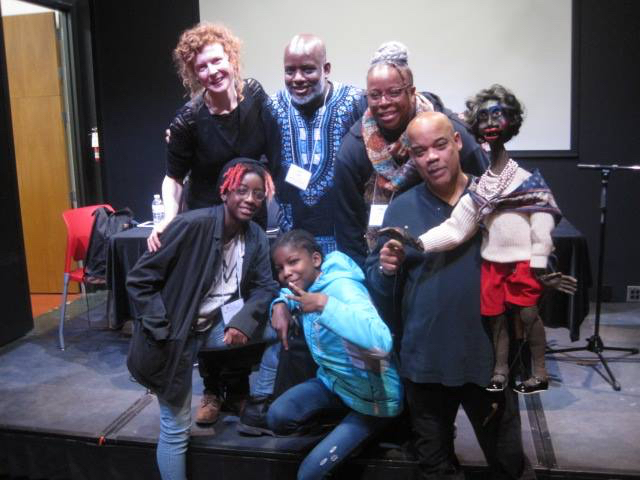
Participants from Baltimore. From left to right: Valeska Populoh, Dirk Joseph, Azaria Joseph, Sequoia Joseph, Sheila Gaskins, and Schroeder Cherry.

Participants from Baltimore. From left to right: Valeska Populoh, Dirk Joseph, Azaria Joseph, Sequoia Joseph, Sheila Gaskins, and Schroeder Cherry.

A Whimsical World: The Puppetry of Drew Allison at the McClellanville Arts Council Gallery in South Carolina

Drew Allison. Photo by Simon Hare.

Drew Allison. Photo by Simon Hare.

Join the McClellanville Arts Council in a celebration of World Puppetry Day which falls annually on March 21. 

The Arts Council will host an exhibit of puppet creations by long-time puppeteer Drew Allison.  Over 25 puppets will be exhibited from past performances, on-camera appearances and commissioned works. 

The story of each puppet and their role will accompany each piece.  Puppeteer Drew Allison will be on hand to chat at the Exhibit Opening on March 21, 2019 at 7:00pm at The McClellanville Arts Council Gallery. The exhibit will run from March 21, 2019- April 13, 2019.

For additional information about Drew Allison and his company called Grey Seal Puppets, see their website at www.greysealpuppets.com or check them out on social media. 

You can contact Drew for additional information as well at drew@greysealpuppets.com

Exciting New Blog Features Puppet Performance Reviews from 1999-2009

Puppets in Review.jpg

Donald Devet recently created a blog featuring puppet performance reviews he wrote while living in New York City from 1999-2009. During those 10 years he reviewed shows by Ralph Lee, Basil Twist, Gretchen Van Lente, Janie Geiser, Liz Joyce, Kevin Augustine, Lake Simons, Edward Einhorn and many more.

Donald’s intent in creating a blog of reviews is to provide a model for other reviewers, both in and out of the puppet world. As you are well aware, puppet performances are often given short shift by many commercial theater reviewers who are oftentimes unfamiliar with puppetry as a theatrical art form and sometimes don’t take the work seriously. 

Because of his extensive background in stage puppetry, Donald has treated the performances in his reviews with respect and has given an honest evaluation of the performers’ intents.

He believes it’s beneficial to puppeteers and the public at large to visit a blog site dedicated specifically to reviews of puppet shows. Donald’s goal in creating “Puppets In Review” (https://puppetsinreview.home.blog/) is to demonstrate that puppetry should be given as serious consideration as any other performing arts genre.

In addition to his own reviews, Donald invites others to contribute to the “Puppets in Review” blog. To begin the process of submitting a review: https://puppetsinreview.home.blog/submit-your-review/

Living Objects: African American Puppetry Festival and Symposium

The Ballard Institute and Museum of Puppetry at the University of Connecticut is pleased to present the Living Objects: African American Puppetry Festival and Symposium to celebrate the rich world of African American puppetry in the United States. This four-day series of performances, presentations, discussions, film screenings, and workshops will take place February 7 to 10, 2019 in Hartford and Storrs, Connecticut.

Activities for the Living Objects: African American Puppetry Festival and Symposium will occur in various venues on UConn’s Storrs campus February 8 to 10, with related festival events with UConn Hartford at the Hartford Public Library on Thursday, February 7, 2019 and at the Wadsworth Atheneum Museum of Art on Saturday, February 9, 2019.

living objects 2.jpg

Attendees have two options to participate in Living Objects Festival and Symposium events:

1.    Living Objects performances in Storrs and Hartford are open to the public. Individual tickets can be purchased at bimp.ticketleap.com.

2.    To attend all Living Objects Festival and Symposium events, including performances, panel discussions, film screenings, and more, registration is required. Registration can be completed at www.cvent.com/d/bbqbh7.

The festival will feature performances by Tarish "Jeghetto" Pipkins, Megan Piphus, David Liebe Hart, Dirk Joseph and String Theory Theater, Pandora Gastelum, Bruce Cannon, Nate Puppets, Yolanda Sampson, Edna Bland, and more!

living objects 3.jpg

These events are part of the current Ballard Institute exhibition Living Objects: African American Puppetry, on display through April 7, which for the first time brings together historical and contemporary puppets, masks, and performing objects by African American artists and puppeteers. Many of the exhibition's contributors, as well as scholars from around the United States, will come together at the festival and symposium to celebrate the past, present, and future of African American puppetry.

Living Objects Festival and Symposium registrants may purchase one-day, three-day, or student passes to attend all festival and symposium events. Registration will include breakfast and lunch. To register for a one-day or three-day pass to the festival and symposium, visit www.cvent.com/d/bbqbh7. To read more about the Living Objects exhibition and festival, visit bimp-exhibitions.org/livingobjects.

Applications Now Open for New Victory LabWorks

The New Victory Theater, New York City’s premier nonprofit performing arts theater devoted year-round to kids and their families and classmates, announces the call for applications to the 2019-20 New Victory LabWorks program.

newvictorylabworks.jpg

New Victory LabWorks is seeking applications from New York City-based artists and companies interested in creating new work for family audiences in the areas of theater, dance, music, circus, puppetry arts and other performing arts.

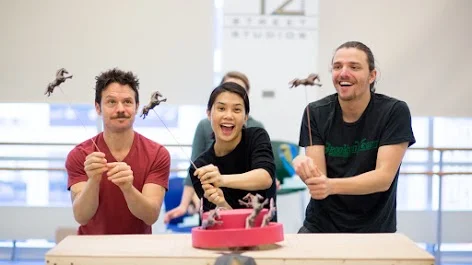
For artists of all disciplines who desire an experience tailored to their specific needs and individual creative processes, New Victory LabWorks offers selected artists a stipend, ample dedicated rehearsal space in the New 42nd Street Studios and the possibility of holding Open Rehearsals for industry professionals, fellow artists and New Victory Member families. Facilitated by New Victory staff, these experiences provide the invaluable feedback of peers and target audiences alike.

Some current and previous New Victory LabWorks Artists include: Molly Powers Gallagher; Hit The Lights! Theater Co; Max Darwin and Alexander Dinelaris Jr.; Nambi E. Kelley; Preeti Vasudevan; Faye Chiao and Anton Dudley; Breton Tyner-Bryan; Bluelaces Theater Company; Aaron Jafferis; Spellbound Theatre; AchesonWalsh Studios; Kate Douglas; Kaneza Schaal and Christopher Myers, and Phantom Limb Company.

For more information, program requirements and the 2019-20 application, visit www.newvictory.org/labworks


For questions, email LabWorks@newvictory.org. Applications will be accepted through Friday, February 1, 2019.

3rd International Conference on Training in the Arts of Puppetry

professional_training_framed.jpg

May 15-20, 2019 in Florianópolis, Brazil

The Third International Meeting on Training in the Arts of Puppetry will address the theme:

Staging and diversity of contemporary theatrical creation processes.

Traditional puppet theater such as the Indonesian, Indian, and Chinese shadows, the Chinese hand puppet theater, the Bunraku, the Pulcinella family, the puppi Siciliani, the Czech rod marionettes - to mention only a part of this vast territory - presents strictly defined forms, adapted to the puppet genre, with a fixed dramaturgical structure and a definite gestural vocabulary. In the traditional repertoire, stories and characters change while aesthetics and impact on the audience remain the same. The type of puppets - their physiognomy, their color pallet and their dynamics - is in perfect harmony with the type of dramaturgy that has been created for them. The puppeteers are committed to achieving the performance virtuosity so much appreciated by the public and the differences between artists are expressed in fine performing nuances and in the fine art aspect of the puppets. The staging, even when it is innovative, follows the codes of each of the forms. With respect to traditional puppet theater training, knowledge is often transmitted through master-student learning.

Contemporary Puppet Theater is situated at the other pole of creation. Inspired by the potential of its new expressive means, artists from the fields of dance, mime and the visual arts turned to puppetry. This encounter has given birth to new and spectacular forms, which combine the puppet with the body of the actor, which invented the  “body masks” and the fictional or imaginary body, and which converge at the intersection of puppetry, acting and mime performance. The imaginary invades the plateau. The staging changes its status; it becomes a conceptual act and the director, a creator.

What dramaturgy must we invent for a theatre that is constantly seeking its form and is continually changing? What will be the markers along the way for the author, the playwright, and the director? Should we create rules and handbooks? Could it be even possible? We know that there is no definitive truth.

Contemporary theater seldom starts with a text written for the stage. Its sources are often a literary text, a musical piece, a theme, an idea, and a desire to question reality. The dramaturgical structure is created for the show; writing and staging must work in a relationship of complicity, evolving together until the end of the creative process.

After having discussed the definition of puppetry and puppet theater in 2015, the pedagogy and the links between traditional and contemporary theater in 2017, the Third International Conference on Training in the Arts of Puppetry 2019 organized by the UNIMA Training Commission in collaboration with the Universidade do Estado de Santa Catarina, in Florianópolis and with the participation of academics, practitioners and students will examine different aspects of the current notion of directing:

• How to define the director? Its functions differ according to the processes of creation and are not definitive.

• How to teach directing? What directing? For what theater?

• What could be the pedagogy for a puppet theater in constant transformation? We should consider that today “the puppet” is born of a profusion of contemporary forms, produced with an overflowing inventiveness: how to approach directing and be able to teach it in this perspective of a theatre in permanent evolution?

We intend:

- To explore what is directing today, in relation to the diversity of the creative processes and the diversity of the dramaturgical forms.

- To explore the pedagogy (s) of directing. How does pedagogy meet the requirements of a theatre, which presents a broad diversity forms?

- To explore the history of the staging to show the various historical periods and the directors thinkers who, seeking to give substance to their shows, had deep reflections with respect to the aesthetics of the show, to the relationship between show and spectator and the impact that the show will have on it.

- To explore the importance (extension) occupied by the visual image in the contemporary theatre, question its functions in the dramaturgy of the show, and the relation with the current technologies.

For this purpose we propose work topics such as:

1. Conference on the evolution of the staging, its goals, its challenges, and the relationship between staging and dramaturgy.

2. The presentation of unique creative processes, linked to artistic personalities.

3. Practical workshops that show various pedagogical approaches to the teaching of staging.

4. Debates and round tables with the guests in the presence and with the participation of students and teaching artists.

The Universidade do Estado Santa Catarina), Florianópolis, will host the conference.

You can find more information on the UNIMA website.
World Cultural Heritage in America

provided by Ayhan Hulagu

PHOTO PROVIDED BY AYHAN Hulagu

PHOTO PROVIDED BY AYHAN Hulagu

Ayhan Hulagu, who established Karagoz Theatre Company in America, has been performing the traditional Turkish shadow puppet theater all over. Taking the stage in America’s various states, especially in Washington DC, Hulagu says that Karagoz attracts more attention abroad.

Since its naming to the UNESCO Representative List of the Intangible Cultural Heritage of Humanity in 2009, Karagoz has started to draw attention all over the world. Lots of panels, workshops and festivals regarding Karagoz have been arranged. Turkish performer Ayhan Hulagu has organized a group of theatre makers with the aim of traveling around America to introduce Karagoz to more people. Hulagu’s first performance was in Washington DC, the capital of the United States. After that he made special shows in Virginia and Iowa. Ayhan’s performance recently served as the opening show of Great Plains Puppet Festival, which is one of the most well-known puppet festivals in the USA. Hulagu opened the festival with his two shows named Swing and The Forest of the Witch, adapted from Turkish veteran Karagoz performer Muhittin Sevilen’s plays. In general, Hulagu prefers to perform Karagoz using both Turkish and English during the shows. Performing under the same roof of Karagoz Theatre Company, Hulagu underlines that the American people are very interested in Karagoz shows.

karagoz-logo.png

Ayhan Hulagu started a project named Karagoz Triplet two years ago in İstanbul. He has taken the stage abroad as part of this project’s second section. He summarizes his project like this: “I started Karagoz Triplet in İstanbul. I performed a Karagoz show in İstanbul’s streets. My second project is Karagoz on the way. Within this framework, I have taken the stage in various countries, especially in America. After I complete my shows in America, I am planning to take stage in Europe. Last part of Karagoz Triplet will be in Turkey, named Karagoz at home. Lastly, I am planning to meet Turkish audiences with Karagoz. In Turkey, I want to express my experiences performing Karagoz shows as I travel all over the world. My time touring in America has been an extraordinary experience for me. Also, it is a big pleasure to have a chance to introduce our traditional Karagoz show all over the world.”

DEADLINE EXTENDED! Build a Sauropod Marionette for the Natural History Museum of Los Angeles County

sauropod.jpg

Submit your proposal by by 4:00 pm on January 14th, 2018 to be considered for this project. NHMLA plans to select an experienced artist to develop and fabricate a new puppet to be used in regular programming at the museum.

Project Goals and Technical Requirements:

The selected contractor will work with NHMLA paleontological staff to develop and create a marionette interpretation of a sauropod dinosaur, the precise species will be determined at the beginning of the development process. Core requirements include:

  • The total budget for the puppet must not exceed $10,000.

  • The puppet must match those visual characteristics outlined during development with paleontology staff.

  • Puppet is capable of interacting regularly with guests of all ages.

  • Puppet should coexist aesthetically with other Dinosaur Encounters puppets.

  • Puppet control design must be ergonomic and practical for repeated use during 30 minute performances.

  • Puppet weight should fall under 15 pounds.

  • Puppet must be delivered, meeting all aforementioned requirements, to NHMLA by March 1st, 2018

Bidding Procedure:

All proposals are due by 4:00 pm on January 14th, 2018.. No faxed proposals will be accepted. Emailed proposals are preferred, but hard copies are accepted. All proposals should be sent to The Natural History Museum of Los Angeles County C/0 Ilana Gustafson at the following address: 900 Exposition Boulevard, Los Angeles, California, 90007. All questions or comments concerning the Request for Proposals should be addressed to Ilana Gustafson, Manager of Performing Arts at igustafson@nhm.org.