World Cultural Heritage in America

provided by Ayhan Hulagu

PHOTO PROVIDED BY AYHAN Hulagu

PHOTO PROVIDED BY AYHAN Hulagu

Ayhan Hulagu, who established Karagoz Theatre Company in America, has been performing the traditional Turkish shadow puppet theater all over. Taking the stage in America’s various states, especially in Washington DC, Hulagu says that Karagoz attracts more attention abroad.

Since its naming to the UNESCO Representative List of the Intangible Cultural Heritage of Humanity in 2009, Karagoz has started to draw attention all over the world. Lots of panels, workshops and festivals regarding Karagoz have been arranged. Turkish performer Ayhan Hulagu has organized a group of theatre makers with the aim of traveling around America to introduce Karagoz to more people. Hulagu’s first performance was in Washington DC, the capital of the United States. After that he made special shows in Virginia and Iowa. Ayhan’s performance recently served as the opening show of Great Plains Puppet Festival, which is one of the most well-known puppet festivals in the USA. Hulagu opened the festival with his two shows named Swing and The Forest of the Witch, adapted from Turkish veteran Karagoz performer Muhittin Sevilen’s plays. In general, Hulagu prefers to perform Karagoz using both Turkish and English during the shows. Performing under the same roof of Karagoz Theatre Company, Hulagu underlines that the American people are very interested in Karagoz shows.

karagoz-logo.png

Ayhan Hulagu started a project named Karagoz Triplet two years ago in İstanbul. He has taken the stage abroad as part of this project’s second section. He summarizes his project like this: “I started Karagoz Triplet in İstanbul. I performed a Karagoz show in İstanbul’s streets. My second project is Karagoz on the way. Within this framework, I have taken the stage in various countries, especially in America. After I complete my shows in America, I am planning to take stage in Europe. Last part of Karagoz Triplet will be in Turkey, named Karagoz at home. Lastly, I am planning to meet Turkish audiences with Karagoz. In Turkey, I want to express my experiences performing Karagoz shows as I travel all over the world. My time touring in America has been an extraordinary experience for me. Also, it is a big pleasure to have a chance to introduce our traditional Karagoz show all over the world.”

DEADLINE EXTENDED! Build a Sauropod Marionette for the Natural History Museum of Los Angeles County

sauropod.jpg

Submit your proposal by by 4:00 pm on January 14th, 2018 to be considered for this project. NHMLA plans to select an experienced artist to develop and fabricate a new puppet to be used in regular programming at the museum.

Project Goals and Technical Requirements:

The selected contractor will work with NHMLA paleontological staff to develop and create a marionette interpretation of a sauropod dinosaur, the precise species will be determined at the beginning of the development process. Core requirements include:

  • The total budget for the puppet must not exceed $10,000.

  • The puppet must match those visual characteristics outlined during development with paleontology staff.

  • Puppet is capable of interacting regularly with guests of all ages.

  • Puppet should coexist aesthetically with other Dinosaur Encounters puppets.

  • Puppet control design must be ergonomic and practical for repeated use during 30 minute performances.

  • Puppet weight should fall under 15 pounds.

  • Puppet must be delivered, meeting all aforementioned requirements, to NHMLA by March 1st, 2018

Bidding Procedure:

All proposals are due by 4:00 pm on January 14th, 2018.. No faxed proposals will be accepted. Emailed proposals are preferred, but hard copies are accepted. All proposals should be sent to The Natural History Museum of Los Angeles County C/0 Ilana Gustafson at the following address: 900 Exposition Boulevard, Los Angeles, California, 90007. All questions or comments concerning the Request for Proposals should be addressed to Ilana Gustafson, Manager of Performing Arts at igustafson@nhm.org.


Material Performance at a Dutch Festival

Pikz Palace company’s Boucherie Bacul. Photo by Colette Searls.

Pikz Palace company’s Boucherie Bacul. Photo by Colette Searls.

by Colette Searls

I recently returned from the 2018 Puppet International Festival in Meppel, Netherlands, which hosted companies from across Europe the week of October 10th – 14th. One of the most exciting performances was the one-night celebration of puppet royalty, Masters@Work, with breathtaking acts by Jordi Bertran, Tristan Vogt (Thalias Kompagnons), Neville Tranter (Stuffed Puppet), and Meppel’s own Henk Boerwinkel. In addition to these standard-bearing stars, the festival offered a balance of outstanding established and up-and-coming companies working in a wide range of puppetry styles. Yet interestingly, some of the most moving shows involved little or no direct human animation – what we might strictly define as puppeteering – but seemed to celebrate the expanding art of puppetry/material performance by other novel means.

The Dutch group BOT offered a particularly touching and mind-bending performance called LEK (Leak/Leaky), a kind of object concert featuring a menagerie of invented (as well as wildly modified) tools and instruments playing with a quartet of musicians. At various points, one of these strange kinetic objects would suddenly jolt to life and move itself autonomously across the stage (particularly eerie was a self-playing cello in a wheelchair). BOT is primarily a site-specific touring company, and one of the performers explained to me that their reputation lies more along the lines of “object performance” (as he put it in English) than puppetry. But after appearing at the World Puppet Festival in Charleville-Mézières, they started hearing from other puppet festivals like this one.

The Meppel festival also proudly hosted the Architects of Air (Alan Parkinson)’s Luminarium, which is not a puppet show, but rather an enormous sculpture you get to walk inside. This beautiful installation looked from the outside like an artsy circus tent, and from the inside like the stomach of some benevolent alien whale. Visitors were invited to enter the colorful curved hallways and rooms, lie down, take pictures, meditate – most folks seemed happy to just find a spot to relax in awe. There were no moving objects and no performers. But the experience was still dynamic – a masterfully designed animation-interaction of hard materials with intangible elements of light and air.

Pikz Palace company’s Boucherie Bacul. Photo by Colette Searls.

Pikz Palace company’s Boucherie Bacul. Photo by Colette Searls.

My weirdest object-performance experience was with Pikz Palace company’s Boucherie Bacul  in Meppel’s town square. I caught this funny, imaginative show during the “Hapas Rout,” where the audience walked to puppet performances staged at local eateries. As we followed our leader through the town square, we came upon this small, blood-splattered butchery with a mix of delight and horror as – upon closer inspection – we realized that this middle-aged couple was serving the flesh of dolls and stuffed animals. Treated as customers, we were quickly ushered into a comically grotesque hands-on toy butchery demo. No Barbies were puppeteered, but many were harmed. Badly. The butchers assured us that they were all well-used, and no longer able to fulfill their toy duties. But that didn’t stop us from cringing while they skinned a Burt doll, or placed a Pikachu in the meat slicer. I don’t know how much irony was intended, or if there was a vegetarian agenda here, but the resonant power of performing objects was as much on display as the pickled Barbie heads.

Perhaps all of this is a sign that puppet festivals today are looking to present an increasingly wide range of performing object work. If so, it may bring more attention to the aesthetic potency – and interdisciplinary reach – of puppetry/material performance as a whole. 

If you’d like more details on the Puppet International Festival in Meppel, please read my upcoming review in the next issue of Puppetry International.

Scholarship Application Deadline Extended to December 15th!

Apply now for the 2019 UNIMA-USA Scholarship to Study Abroad!

ELIGIBILITY

All candidates for scholarships must: 

• Be citizens or permanent residents of the United States

• Be a current member of UNIMA-USA

• Be over the age of 18

• Have some experience in puppetry or/and a university degree showing an interest in puppetry

• Applying for aid to study with a recognized puppetry professional or professional program outside of the United States, or to attend an international puppetry workshop. Independent study plans are also eligible.

HOW TO APPLY

In addition to the application form, please send the following materials to scholarship@unima-usa.org:

• 3 letters of recommendation from master puppeteers or professors in puppet theatre with whom you have worked or who know your work

• 5 images of your work

Questions? Contact Scholarship Representative Honey Goodenough atscholarship@unima-usa.org.

Tribute to Margareta Niculescu, UNIMA President of Honor

December 15th, 2019, at 7 PM  | Charleville-Mézières

For this well-deserved tribute, we join the International Puppetry Institute, the World Festival of Puppetry Arts of Charleville-Mézières, THEMAA and Latitude Marionnette to honor the memory of this great woman for her huge contribution to the Puppetry Arts throughout her life. The world of Puppet Theater will always be in mourning.

Margareta_Niculescu_C-Loiseau2.jpg

This evening will offer the opportunity to go through the main stages of her career and her visionary thought.

We invite you to join us for this tribute to be held on December 15 2019, at 7PM at the Theater of the National Superior School of Puppetry Art (16 avenue Jean Jaurès, Charleville-Mézières - France).

Reservation required at the International Puppet Institute: +33 (0) 3 24 33 72 50

2018 UNIMA-USA Scholarship Recipient: Liz Oakley

A report by Liz Oakley

Hello from Paris!

It is hard to believe that almost a year ago I was working on my application for UNIMA-USA’s annual scholarship to study abroad. Thanks to the committee’s generosity, I am here in Paris participating in the 5-month Annual Training for actor-puppeteers at the Théâtre Aux Mains Nues. Having spent the years during and after college exploring my love of puppetry in many forms, mostly in my free time, I decided it was time to make a choice to commit myself more seriously to the craft. I felt that the time was right for a more sustained training program. Inspired by the prospect of the UNIMA-USA scholarship, and eager to experience puppetry outside the United States, I did some research, found this very unique program, and applied. And here we are!

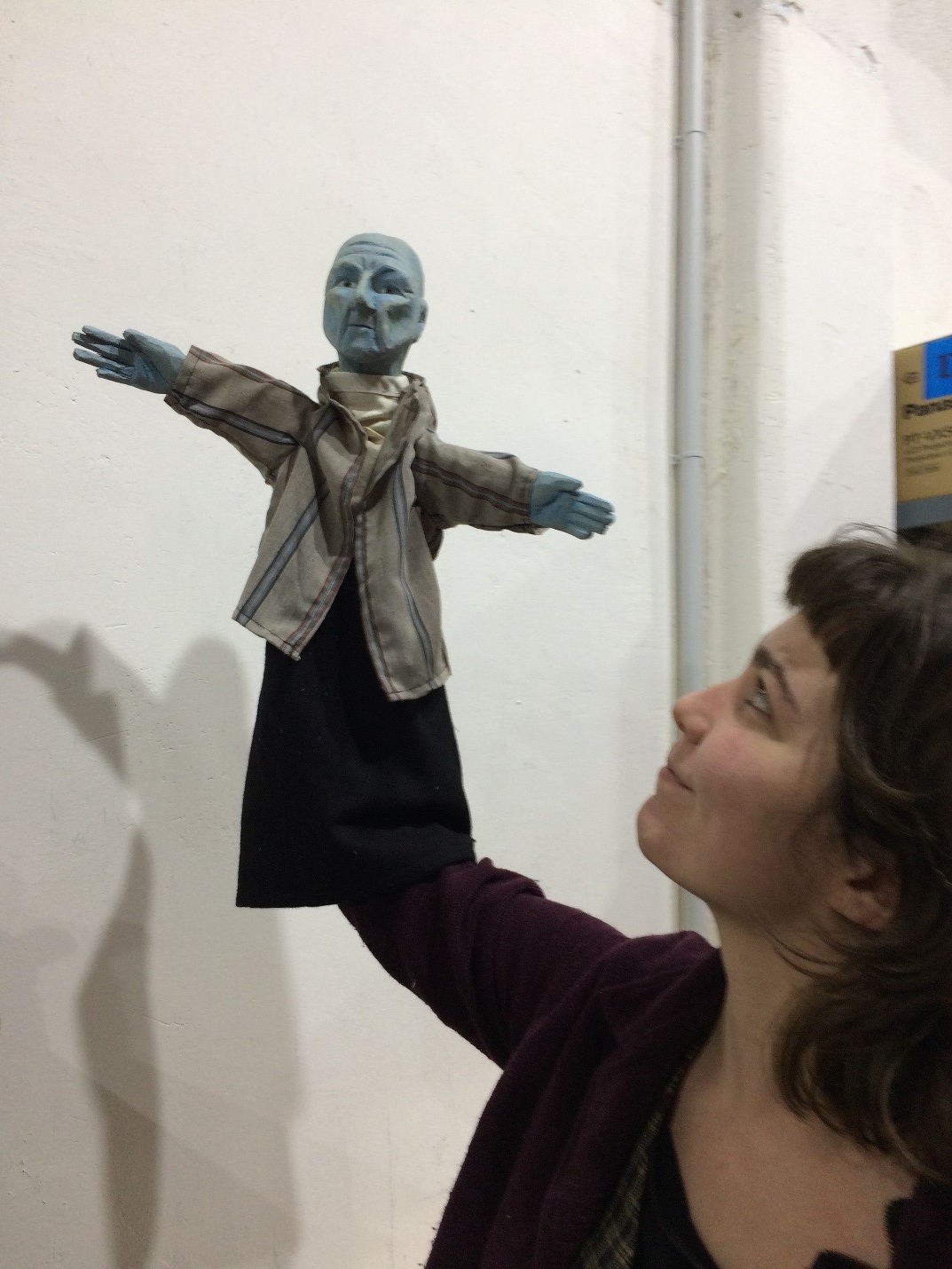
Liz and her completed marionnette à gaine

Liz and her completed marionnette à gaine

We just finished the sixth week of our training here, which is four full days per week. The program is very small, with only seven students; four from France and three from abroad. The coursework includes a rotation of core classes, which include voice, body, acting, principles of animation, and glove puppet manipulation (in French, marionnette à gaine). This particular technique is completely new to me and has been fascinating to dive into. The style of puppet has a long history in France, famously in the form of Guignol. In our other classes we work with and without glove puppets, and have more recently begun exploring object manipulation. We will encounter many more styles and forms in the weeks to come, drawing from the theater’s supply of many different styles of exercise puppets. Soon we will also be moving into a phase of the training where each week a different guest artist comes to do a mini-unit with us on a particular style of puppetry. I am particularly looking forward to two full days that we will spend at a giant puppetry studio. In the last phase of the training, we will be creating a collective final piece for public presentation with a guest director, Claire Heggen, and designer, Pascale Blaison.

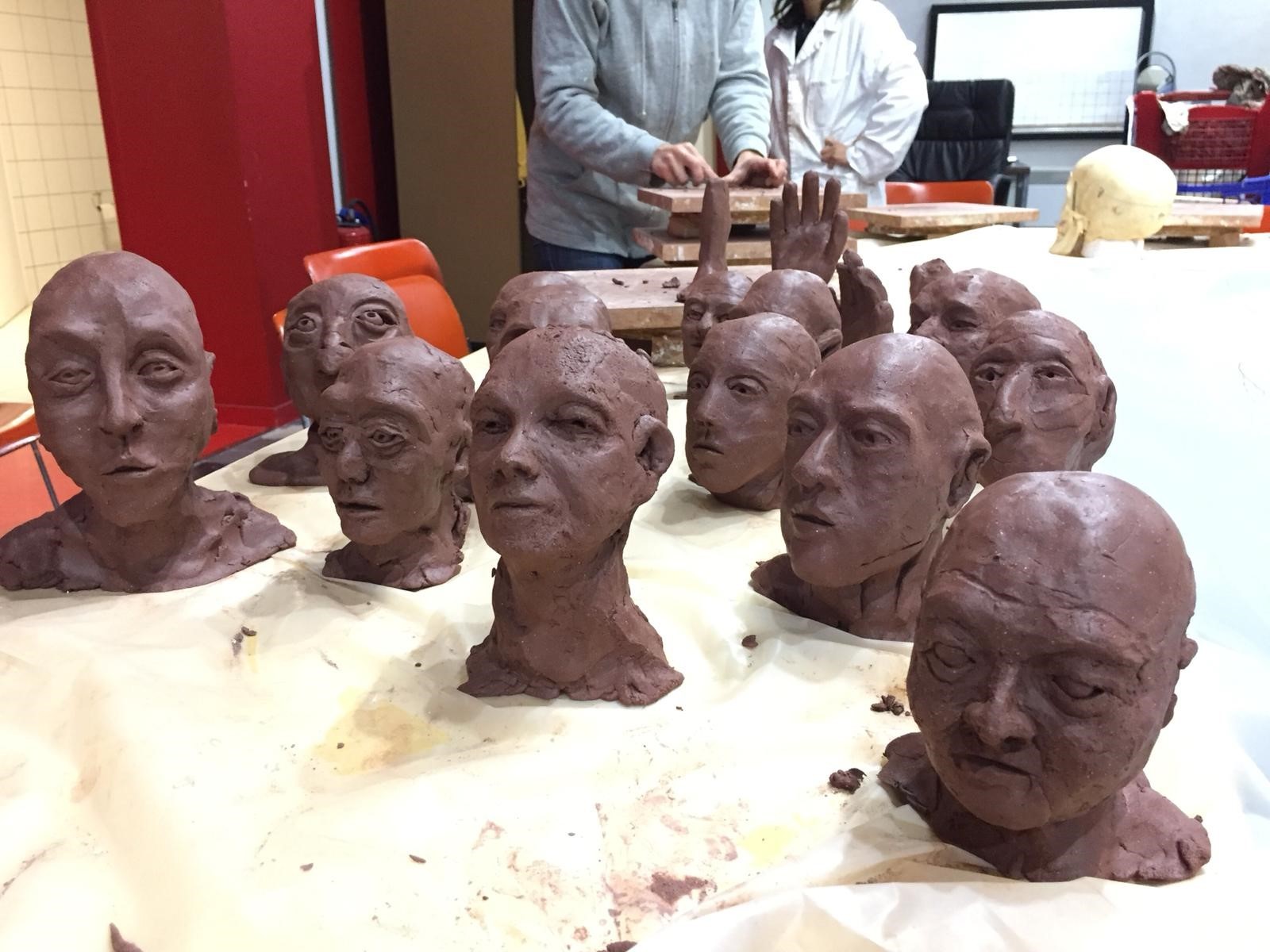
Just last week, we all finished making our own "Gaine Lyonnaise" from start to finish. We followed a specific traditional pattern from Lyon to make the glove/body, and each constructed our own unique heads out of clay, which we then finished with paper-maché. We'll be using these puppets going forward in our courses as exercise puppets.

Clay heads in progress.

Clay heads in progress.

 Not only has the training itself been incredibly rich, the team of instructors, resident puppetry companies, and theater staff at TMN have made this experience especially unique. I have already been able to see several excellent puppet theater performances, at the Théâtre Aux Mains Nues and the Théâtre Mouffetard, another theater in Paris that exclusively programs puppetry. There are several other upcoming puppetry performances and festivals in town that I am really looking forward to. It has also been a wonderful treat (and challenge) that the program is entirely in French. Many people have been delighted that news of the theater has made it to the United States, and are surprised that I have come to France just for the training. I always credit UNIMA-USA for getting me here; both for providing the scholarship itself, and for maintaining an excellent listing of programs, workshops, and festivals abroad. I would not have taken this step without their support, and it has already opened me as an artist to be here in ways I could not have imagined. And we aren’t even halfway through! Here’s to seeing what the next three and a half months bring.

2018 UNIMA-USA Scholarship Recipient: Valerie Meiss

A report by Valerie Meiss

I received the 2018 UNIMA-USA Scholarship to Study Abroad, and it seems cheap to call it “life-changing”. I will say that any attempt to explain my experiences, studies, the friends I made, any of it, will fall short.

In 2017, I attended a masterclass at The Center of Puppetry Arts with Hachioji Kuruma Ningyō, a puppetry troop from Japan, led by Koryu Nishikawa V. Kuruma Ningyō incorporates all the beauty and fluidity of movement of Ningyō Jōruri (bunraku) style, but performed by a single puppeteer, on a small cart. I told Nishikawa-san I wish I’d known to seek it out when I was in Japan (months earlier). He told me the next time I was in Japan he could teach me this style and more.

I applied for the scholarship to do just that, and attend the Iida Puppet Festa, an international festival in Iida, Nagano. I was also invited to teach my own workshop at a small craft cafe in Tokyo.

Practicing with Japanese traditional puppets in Iida.

Practicing with Japanese traditional puppets in Iida.

My time in Hachioji was brief but incredible. I dropped in on a summer program and stayed after to watch the troop rehearse. My Japanese is limited (but functional), so most of my learning was movement-based. My notes consist of sketches, designs, and shorthand directions. My last evening there, during a typhoon, we lost power. We spent a few hours in the dark theatre, playing Japanese pop songs (of which I know exactly one, but it was played) on a guitar. It was one of many unexpected moments of “cultural exchange” that I treasure most.

The following days were spent in Iida, which, on its surface, seems entirely devoted to apples and puppetry. The city is full of public art on these themes, including a “Puppetry Clock” which every hour, invites passers-by to see an animatronic puppet show, with an appearance by “Poh”, the yellow-clad, apple-hatted mascot of Iida Puppet Festa. I saw shows and met puppeteers from all over. Highlights included the following: speaking Japanese to a man who translated to Russian for new Russian friends; trading phrases with puppeteers from the Basque country, as they taught Japanese kids “The Macarena” in giant parade puppets; unexpectedly finding a new best friend with limited English, and falling in with his troop, Divadlo Alfa, from the Czech Republic (who I’ll visit soon, after this chance run-in); and being taken to lunch by a Japanese grandmother and grandson, to whom I gave some of my workshop eyeballs (“te-me”, meaning “hand-eyes”).

In Iida, I continued studying Kuruma Ningyō, as they were also there. Before leaving, I said goodbye to my sensei, who I’d not see for the rest of my trip. I tried to explain in Japanese how grateful I was for this opportunity, but that I didn’t have words in Japanese, nor in English. “It’s overwhelming!” I said in English, because I don’t know that word in Japanese. “Ah! Overwhelming!” Nishikawa-san exclaimed, understanding.

I still don’t have words, in either language. Only “overwhelming.”

I adjusted a few days of my trip to visit my new Czech friends in the tiny town of Higashi-kagawa. Divadlo Alfa was performing their Three Musketeers show at Toramaru Puppet Land, a set of plain buildings on a hill in the middle of nowhere. Inside is like a Japanese version of the Center for Puppetry Arts. It has an incredible theatre and museum, complete with hands-on learning, a monitor set-up, and one of the densest puppet-populated rooms I’ve ever seen. I was only there for a day, but it was one of my favourites from that trip. Plenty of this trip I knew would blow my mind, but it was the unexpected detours that stick with me the most.

Workshop at Sheena to Ippei, photo by Shota Kaneko

Workshop at Sheena to Ippei, photo by Shota Kaneko

Back in Tokyo, I had a workshop. I had some puppets with me, and a tanuki hand-and-rod style puppet I made just for this trip (and used throughout, to the delight of children and several adults). We used sets of te-me I made, and worked on characterization through movement. Before long we were sticking the eyes on inanimate objects and creating new characters. It was a true test of my Japanese (one of many) and a perfect day with new friends.

Toward the end of my trip I no longer felt sad if I missed something,“I’ll be back,” I realized. This scholarship was an introduction to so much: Kuruma Ningyō, Japanese (which I studied nonstop since accepting the scholarship), Czech puppetry (I’m set to do more with my friends over there), and has become fodder (both in content and design) for my work in progress.

If anyone is interested in this scholarship, apply for it. You’ll learn so much: what you intended to learn, and so much more, if you’re willing to work for it and wander off-course a bit.
I recommend it.

P.S. Learn the language.

Tanuki-chan (puppet) and friends. From Soh’s (center) Instagram.

Tanuki-chan (puppet) and friends. From Soh’s (center) Instagram.

Build a Sauropod Marionette for the Natural History Museum of Los Angeles County

Realistic T. rex and Triceratops large-scale puppets capture the imaginations of audiences in performances each week at NMHLA

Realistic T. rex and Triceratops large-scale puppets capture the imaginations of audiences in performances each week at NMHLA

The Natural History Museum of Los Angeles County (NMHLA) is inviting you to respond to this Request for Proposals. NHMLA plans to select an experienced artist to develop and fabricate a new puppet to be used in regular programming at the museum.

The Performing Arts program is dedicated to providing the communities of Los Angeles County with performances that explore and interpret the intersection of history, art, and science using puppetry and its associated arts. The program currently produces the popular Dinosaur Encounters and Ice Age Encounters performances alongside a wide variety of other museum theater offerings based on events and exhibits. The program strives to exemplify and iterate upon the museum’s vision in all of its endeavors— to inspire wonder, discovery, and responsibility for our natural and cultural worlds.

Project Goals and Technical Requirements:

The selected contractor will work with NHMLA paleontological staff to develop and create a marionette interpretation of a sauropod dinosaur, the precise species will be determined at the beginning of the development process. Core requirements include:

  • The total budget for the puppet must not exceed $10,000.

  • The puppet must match those visual characteristics outlined during development with paleontology staff.

  • Puppet is capable of interacting regularly with guests of all ages.

  • Puppet should coexist aesthetically with other Dinosaur Encounters puppets.

  • Puppet control design must be ergonomic and practical for repeated use during 30 minute performances.

  • Puppet weight should fall under 15 pounds.

  • Puppet must be delivered, meeting all aforementioned requirements, to NHMLA by March 1st, 2018

Bidding Procedure:

All proposals are due by 4:00pm on December 15, 2018. No faxed proposals will be accepted. Emailed proposals are preferred, but hard copies are accepted. All proposals should be sent to The Natural History Museum of Los Angeles County C/0 Ilana Gustafson at the following address: 900 Exposition Boulevard, Los Angeles, California, 90007. All questions or comments concerning the Request for Proposals should be addressed to Ilana Gustafson, Manager of Performing Arts at igustafson@nhm.org.

Long Range Planning: Puppets for Peace

A Tarumba - Teatro de Marioneta from their production This is not Gogol’s Nose. A Tarumba performed and taught toy theater workshops at pop-up puppets in stockholm, sweden.

A Tarumba - Teatro de Marioneta from their production This is not Gogol’s Nose. A Tarumba performed and taught toy theater workshops at pop-up puppets in stockholm, sweden.

by Kathy Foley

Geoffrey Cormier asked me to blog on Long Range Planning for UNIMA-USA.  I went for a walk in the meadow and thought, "Okay, what is the plan?"  And then I thought, "World Peace."  I thought about this especially because of the world we live in now. With the distance between manipulator and the manipulated on the Internet, we are seeing an increased space between crafter and the creation, which is sometimes ugly.

Of course non-puppet people think that is what puppetry is about—hiding behind and pulling strings. But anyone who has been above or under an actual puppet knows that what you can do with the figure is already implicit in its make-up. We are attached to our object and in it—one thing with it. One of the beauties of puppetry is that it can range from very small (think toy theatre) to very big (think King Kong on Broadway). What is great about UNIMA is it puts us, through festivals, commissions, and publications, in contact with others who understand that connection of made environment and self and, like us, use objects to explore important stories. We are puppet people.

We live in a world which needs more empathy and hearing across national and international divides. UNIMA-International next spring will hold its 90th anniversary with performances of stories of friendships through puppetry that crossed "enemy lines" in WWII. These are stories about peace with others and our world. 

I spent my summer seeing our common concerns first in Asia and then in Europe. I was invited to speak at first the International Conference on Islamic Thought and Culture in Perak, Malaysia. I reminded the speakers gathered from across the Muslim world as we talked about curbing terrorism, using religion as a force for good, and creating a just social order that puppetry is one of the deep historical arts of the Islamic world from Karagoz (created we are told by the dervish Seh Kusteri) to the Indonesian saint and puppet master Sunan Kalijaga. Object theatre is to share visions of goodness and justice.

Soon thereafter, I was speaking in Sweden for a seminar at Pop-up Puppets at the Marionetteatern's 60th anniversary in Stockholm where Punch, Pulchinella, Pochinelle, and Dom Gil performers had gathered from across Europe to perform alongside troupes that were creating new work to respond to the migrations and rise of xenophobia in Europe from the immigrations due to the crisis in the Middle East. I reminded the seminar that the comic clown associated with traditional European puppetry has iconography and that swazzle voice that may trace back to north India and the interrelationship of "gypsies" (i.e. migrating groups) and those puppet traditions can be pointed out historically. Most of our great puppet clowns are at least cousins. We may not have DNA kits for figures—but we can trace the path of first mentions (often in police records complaining of the puppeteer-acrobats-dancers-musicians-tooth pullers that pull into town).

Among the artists who were co-presenting were NY puppeteer Roman Paska who I had first met on a puppet stage one night in Indonesia. Also there was the head of UNIMA-International Dadi Pudumjee whose Ishara Puppet Trust welcomes puppeteers from all over the world to perform each spring. Dadi had studied in Sweden in the 1970s with  Michael Meschke who founded the Marionetteatern in 1958 (Meschke was himself a Jewish refugee from Nazi anti-semitism). Meschke long had collaboration with Asia and he helped popularize Bunraku style manipulation now so popular in the west. Meschke's early Ubu Roi which mixed puppets, body puppets, and avant-garde imagery was part of the display we saw in the newly opened performing arts museum—his reaction to the propaganda of WWII and the early Cold War. Meschke made peace with puppets--doing workshops in India, Thailand and beyond. He was one of the ones who put UNIMA back together again after WWII. Helena Nilsson, current head of the company, and Margareta Sorenson, who put together the seminar, were carrying on Meschke's vision: peace via puppets. Use art to talk about connections, to greet refugees, and to help solve misunderstandings.

When Jim Henson went for a walk on a British heath while brainstorming about an internationally syndication-potential TV show with puppets, he had a brainstorm: "World Peace," he suggested, should be the nub of the show. It became Fraggle Rock. Henson who was founding president of UNIMA-USA was also propelling us toward peace in founding our organization. We make puppets, not war.

We recently sent our greetings to UNIMA-Russia on their 60th year (see Kurt Hunter’s video of congratulations). We look forward to our Prague Spring in 2019 when UNIMA-International will toast its 90th year. We are an organization that crosses time-zones, borders, oceans. The marionettists and the Robotics nerds are friends. Our long-range plan is a just, equitable, and peaceful world where we and the material world—our puppets—are in sync. The puppeteer and the object must always be one for the show to go successfully on.   

Puppetry International Online: A Note for Members from Andrew Periale

PI#44-Cover.jpg

If Issue #44 of Puppetry International has not arrived in your mailbox yet, it will soon. As an UNIMA-USA Member, though, you can enjoy it right now on your laptop, tablet, smartphone or any other device you use to link to the internet. Just go to the Current Member Portal. Once you log in with your current Member password, you can read the entire magazine. This is the "Puppetry and Social Justice" issue and it is full of compelling stories about people who are working to make a difference, and, of course, lots of amazing puppets! Happy reading!

--Andrew Periale, Editor of Puppetry International Magazine

Read more about issue #44 in our Puppetry International Index. You can purchase copies in our online store.