UTOPIAS AND WORLDMAKING
SPRING/SUMMER ISSUE NO. 59
Table of Contents • Editorial • Abstract
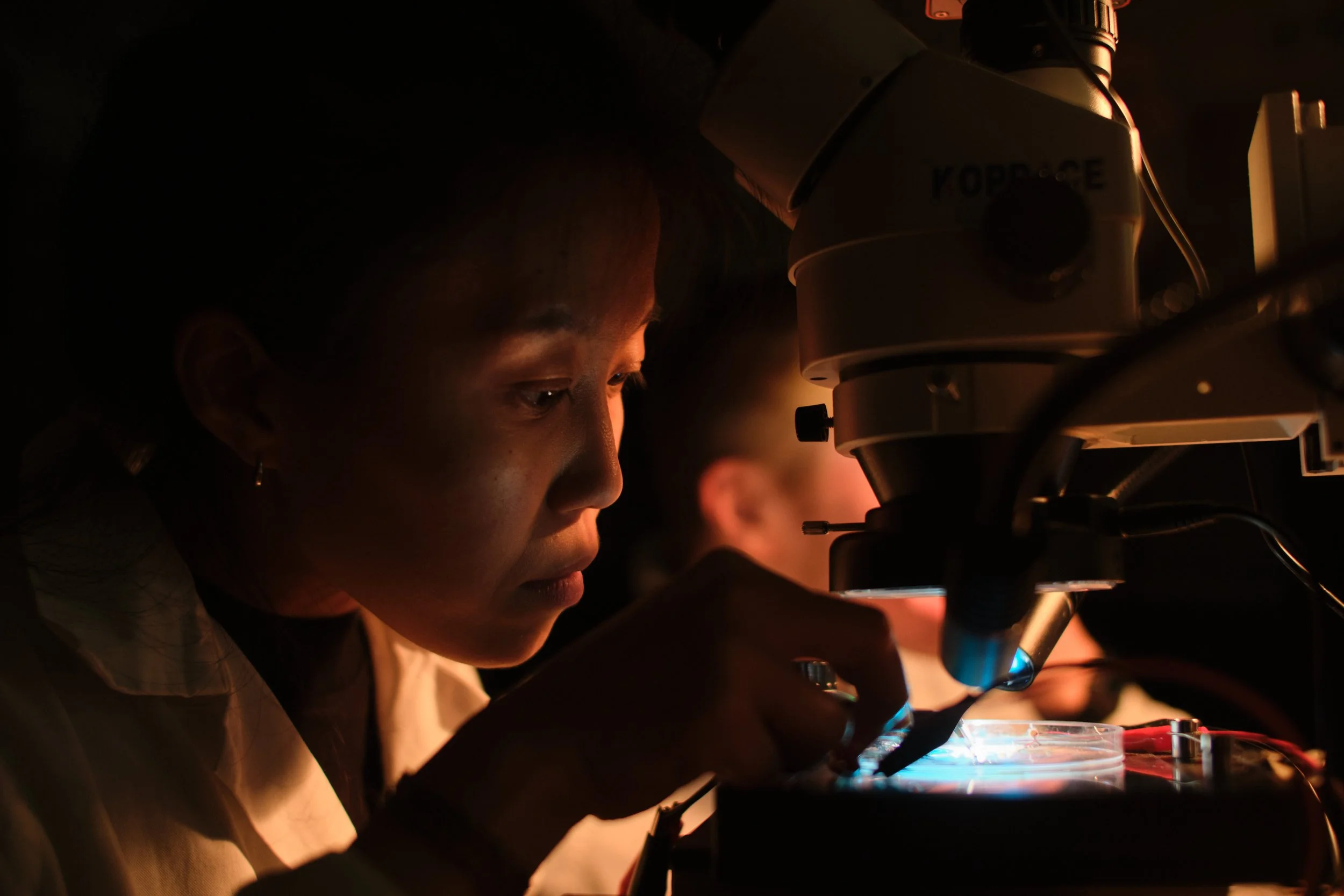
Puppeteer En Ping Yu preparing the stage for puppets in Nano Steps - Into the Lab
PHOTO BY Michael Lozano
The Physics Laboratory as a Puppet Stage
Valtteri Alanen & Iiris Syrjä
I have the rod of a puppet in my hand. Grasping the rod lightly, most of the work is taken on by the pinky and the thumb. The index finger, middle finger and the ring finger provide support and fine adjustment to the hold. The edge of the rod rests on the heel of my hand; I feel the firm but supple wooden surface, almost as warm as my hand, against the surface of my skin. I can also feel the tension formed between the hand of the anthropomorphic figure, extending from the other end of the rod, and the objects it touches, its environment. My environment. Gravity, surfaces, the other parts of the puppet, its limbs with their joints and the effect of them all moving together and against each other are mediated through the puppet-body, into the rod, and along the rod into my hand. The nerves of my hand deliver the sensation of touch to my central nervous system, all the way to the unbridled bundle of nerves that is my brain. What follows then I don’t quite understand, and as far as I understand, even the scientists studying this matter don’t quite understand. Somehow my consciousness assembles into a reality in which I puppeteer the puppet, but at the same time I am being puppeteered myself, as an effect of the puppet, and in fact most of the time it is quite unclear where exactly does the “me” end and the “puppet” begin, or the “puppet” end and the “environment” begin. Who does the experiencing and of what? And what is really being manipulated here, in the end? – Alanen 2022
World's smallest puppets
The Nano Steps performance series by our collective, Trial & Theatre, began with the question: what is the smallest possible theatrical puppet? 1 Our answer led to performances featuring two kinds of performative actors: us as performer-physicists and non-human microparticles as our puppets, objects of inquiry that are not visible to the unaided human eye. 2 The human performer and the smallest puppets in the world. Since the beginning of the project, we have wanted to figure out what happens when we bring the tools and samples from physics laboratories to the stage and operate them in real time as a puppetry spectacle.
This opened up a horizon of inquiry about performance and agency. 3 What kind of performative agency do imperceptibly small pieces of matter hold over the human on stage? What is the nature of relationships between the researcher and their research object, and the puppeteer and the puppet? How do these relationships interact? What do these interactions reveal about knowledge production in arts and sciences and thus of the way we build our shared worlds?
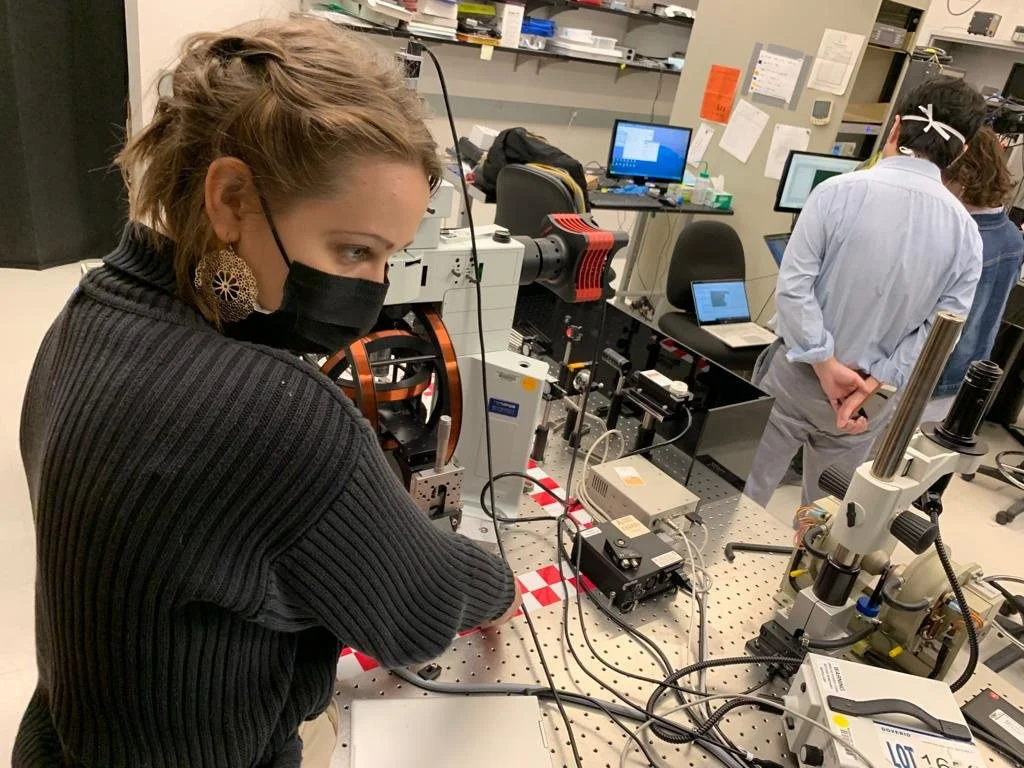
Dramaturg Iiris Syrjä puppeteering with a magnetic field in a laboratory in Cornell University 2022
PHOTO BY Aati Hanikka
Puppetry in the labs of Cornell University
When visiting Cornell University in the United States for research and development for Nano Steps, we were presented with research projects in which the objects of study ranged from robots and origami vastly smaller than a single crystal of salt to microparticle groups that self-assemble in different shapes and compositions. All of the research shared the basic gesture of a human-researcher manipulating something hard to discern and usually invisible to the naked human-eye.
In one of the laboratories, a microscope offered us a view of origami nano-robots— consisting of glass sheets only a few atomic layers thick—clearly waving at each other. In another lab, we witnessed masses of spheres only a few micrometres in diameter being moved around and assembled into neat shapes with the force of mere sound waves. The researchers understood their microparticles so well that they knew how to manipulate them, and what to do to achieve desired behavior with the particles. At the same time, the air was thick with possibility and hope for something unforeseen, not-yet-witnessed, and as-of-yet unknown to unfold. This contradiction is at the heart of the scientist's motivation to do their work. The basis for any research is a thorough understanding concerning the object of study, and the possibility for encountering the unknown and the surprising.
A very similar contradiction is present in the relationship between the puppet and their puppeteer. The puppeteer knows the limits of the puppet, and the conditions for its movement. But crucially, a working relationship between the puppet and the puppeteer also requires the possibility of the surprising and the unforeseen. In the tender animating grip of a skilled puppeteer, the puppet may, at any time, likewise animate their puppeteer. From the point of view of the puppeteer:
I do not move my hand like this in order for the puppet to seem like it does something. Instead it is absolutely necessary that I move my hand in this particular manner because the puppet is already doing something (Alanen, 2022).
At the beginning of a performance, the puppeteer is like the scientist expecting that the experiment will produce results roughly in line with prior knowledge and experiences in rehearsals. Nevertheless they are incessantly hoping for the experiment to yield the most inspiring result—something surprising, something they are unable to explain, something unknown—that the experiment itself will take the reins.
In our performances, both the first, Nano Steps – a Particle Performance, and the second interactive performance, Nano Steps – Into the Lab, we had two microscopes: one for showing to the audience acoustic manipulation and another for electric-field manipulation. These two techniques are currently under development in applied physics. The view from either or both microscopes was projected onto a huge screen at the back of the stage.
Many of the scenes were based on precise reproduction of minute technical details—ultrasound frequencies, materials of the particles and precisely mixed suspensions—but the final result was always based on a shared structured improvisation between matter and manipulator. For example, in one scene we have a tin particle placed between particles of playground sand, all being pushed about by acoustic energy under a microscope. 4 One performer follows the movement of the particle on the petri dish, manipulating the lens of the microscope to keep the particles in view, while another performer adjusts the amplitude and frequency of the sound waves to allow for the chosen particles to act. A pre-composed soundtrack provides impulses and a frame for narrative interpretation of the journey of the particle. To some extent the scene was based on how much performers had rehearsed and acquired fine-tuned mastery over the technical tools and details, but the exact behaviour of the particles, and thus the content and narrative of the scene, were always unknowable beforehand.
In the Contraption of Intra-activity
In order to trust what the telescope revealed it was essential to believe that it did not deform vision but enhance it. One had to believe instruments were a source of knowledge, and abandon the deeply-rooted anthropocentric view that only man’s natural and unaided sight could build knowledge (Rossi, 17).
Paolo Rossi claims that the introduction of mechanical instruments and experiments into the very heart of scientific practice, for example by Galileo Galilei and Isaac Newton, has functioned as an essential condition for the scientific revolution at the dawn of the modern age.
Object- and tool-oriented work underpins modern science, especially in the natural sciences. Scientific instruments have become the human researchers' unconditional partners in building knowledge. The telescope strengthens human sight telescopically under the specific conditions of its own materiality. In this way, these objects and tools can be thought of as companions in thinking. The same goes for puppet theatre: the marionette and the glove puppet necessarily tell stories differently by the virtue of their different construction, and as such they are vital companions in performance making.
Philosophically, our approach when making Nano Steps flirts with post-humanist and new materialist ways of thinking and draws on the conceptual frameworks of feminist-philosopher and physicist Karen Barad (2007), theorist Jane Bennett (2010), historian of science Rossi (2001) and puppetry-artist Ishmael Falke (2021, 2026). 5 We use and combine these tools of thinking with our own experience as puppet-theatre artists, visits to the physics laboratories at Cornell as well as other research facilities, and taking part in daily life at the labs. 6 Following the work of scientists formed the basis for our Nano Steps performances. On our visits to different research groups we spent a lot of time discussing their scientific work and methods, and reflected on the relationship between puppetry and physics (as well as the very similar socio-economic conditions concerning artists and scientists). In addition, we had the opportunity to follow concrete research activity in the laboratories and gave the scientists workshops in basic puppet animation.
One observation stood out as a stark common denominator for both science and puppetry. Being reciprocally affected by the other-than-human seems to be at the core of doing science just as it is at the core of doing puppetry. Following Barad, we would describe both practices as intra-active apparatuses.
However, having worked with Barad’s theories through translation, we found the concept of apparatus a bit unbecoming of puppetry. In the original essay, written in Finnish, we contemplated the Finnish translations of apparatus to koneisto (machinery) and välineistö (equipment) in the context of puppetry with some dissatisfaction. 7 Instead of koneisto or välineistö, we have in Finnish resorted to härveli, which more readily translates back to English as “contraption.” In Finnish, härveli often implies a complex, perhaps slightly messy or idiosyncratic machine. It also carries with it a much more fun nursery rhymish tone and an adopted-from-the-vernacular whiff of ontological unpredictability than apparatus, containing a bit more of a certain philosophical cleanliness. Contraption captures the messy sense of doing performance with objects and materials central to our experimental approach to puppetry, and so we use it here instead of apparatus, despite consciously applying Barad's thought to our practice.
The puppet theatre contraption is often disassembled to three distinct actors: the puppet, the puppeteer and the audience. As depicted in the phenomenological reflection opening this text, the actual act of puppeteering is not so readily collapsible to such clear-cut categories. Puppet-theatre only really starts happening when the distinctions have already started phasing into each other: affects and effects leak from subjectivity to another placing their essentialised and preconceived separability under question.
The scientific laboratory contraption is also often deconstructed as a trio of actors: the object of research, the researcher and the tools of research. The consciousness of the scientist, working in the physical space of the laboratory, forms interpretations based on different observations and interacts with both the object and the tools of research. Following the thought of Barad it is evident that in order to perform scientific work, the scientist must enter an entangled state with their object as well as their tools of research, delineating the cartesian cut between them in everyday understanding. As the puppet and puppeteer in performance, the scientist and instrument are not unequivocally separable when performing research. They start co-forming, blurring the limits between the subject and the object.
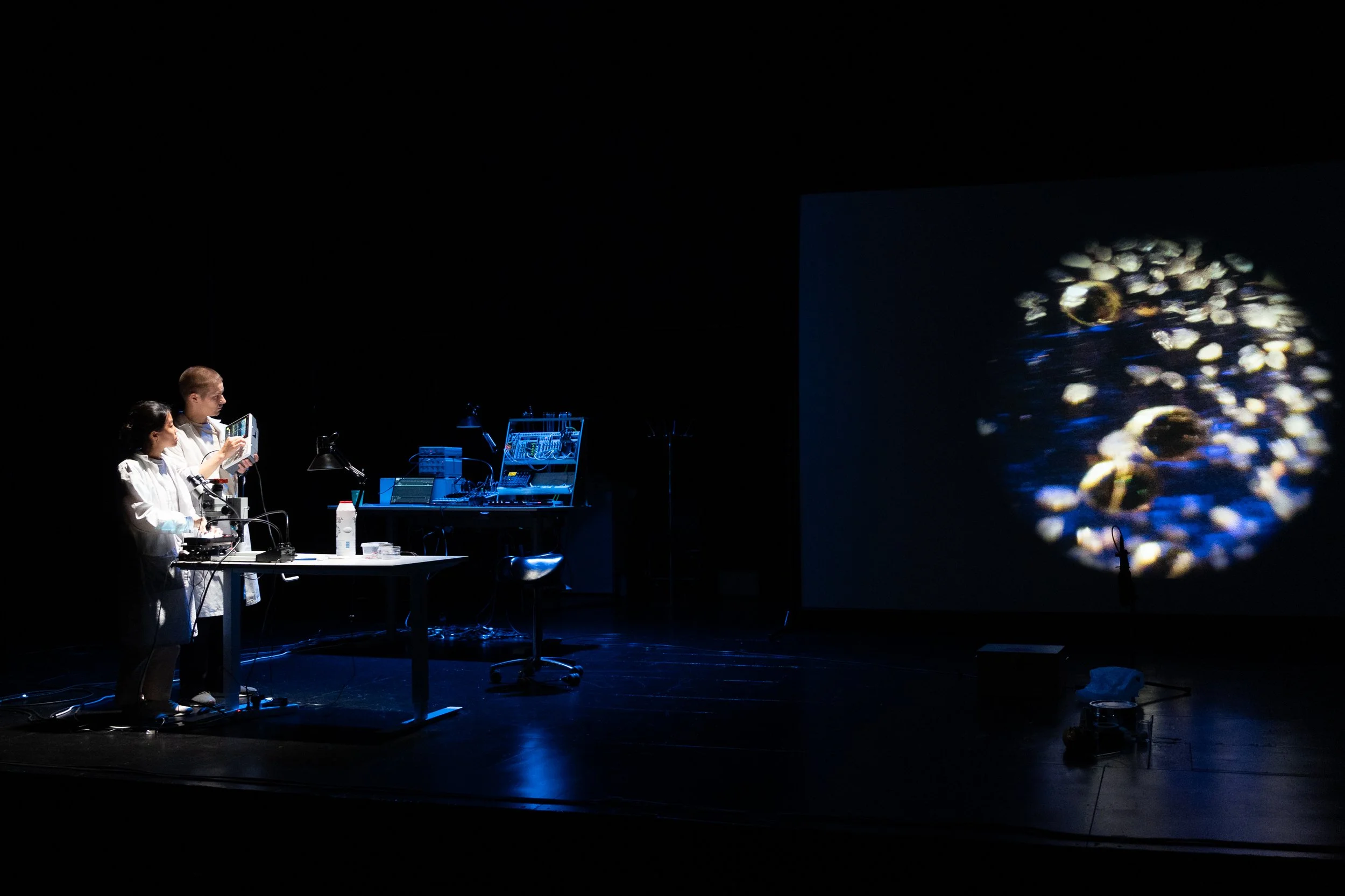
Puppeteers En Ping Yu and Valtteri Alanen acoustically animating the microscopic tin particles in Nano Steps - a Particle Performance in Helsinki City Theatre 2023
PHOTO BY Miika Storm
On Subjects and Objects
The topics of power and control are a staple theme in puppetry. This makes sense, as the theme is an organic part of the relationship between the puppeteer and the puppeteered. 8 The audience is aware of the rules governing the play, and usually conceives of them through definite roles: the puppeteer and the puppet, the subject and the object, the cause and the effect. Everyday imagination understands the puppeteer as someone manipulating their puppet, giving it a sort of life or at least an illusion of it. The power dynamic is readily apparent and easy to grasp. However, as our gesture of “puppetrialisation” of the research in physics demonstrates, the relationship between the puppet and the puppeteer is never this straightforward or unidirectional, especially from the perspective of the puppet or the puppeteer.
So, following puppetry, neither the physicists’ laboratory nor its instruments are mere things or mute objects. But have we undermined the exclusivity of the human-scientists right to subjecthood with this argument? Perhaps not, but it is exactly the subjectivity of subjecthood that is being uncovered as the laboratory is grasped as a puppet theatre stage. Like the puppet, that requires specific actions from its puppeteer, the laboratory, the samples and the data acquired all direct and orient the scientist and thus also their research. The scientist is not free to declare the nature of reality according to their whims, as an exclusive privilege of a Cartesian subject. They must trust and follow their empirically acquired data, that give bounds, direction and foundation to the understanding of reality built through research. The contraption is foundationally puppet-theatrical: a subject-object-relationship that reveals the incoherence of all subject-object relationships (Alanen, 10-11).
Often new materialist, posthumanist or animistic thinking are understood as challenging the fundamental conceptualisations of truth in enlightenment thought and sciences, and thus for example questioning the feasibility of research in STEM sciences. If our hypothesis is that the scientist is controlled by their object of research despite feigning mastery of their situation, can it really be posited within the world of physics, chemistry and biology? To contrast, professor of physics and writer Kari Enqvist makes an interesting analogy between art and science in his book Näkymätön todellisuus, providing a critique of the notion that anything concerning the nature of knowledge could be surmised from studying the relationship between the scientist and their object of research (148, 150, 174). “Probably no-one can, with a straight face, make the claim that we could reveal anything about the notes of a symphony by studying the relationships between the members of the orchestra playing it” (Enqvist, 147; translated by the authors).
It is not our aim, however, as we believe to be the case for our sources, to deprive humanity of agency altogether or negate the achievements of so-called hard sciences. On the contrary, is it not precisely also human freedom and agency that are amplified, by reaching a deeper understanding of oneself in relation to the world one exists in? By intermingling different points of view we wish to bring forth another kind of thinking. We wish to tamper with entrenched dichotomies like nature–culture, alive matter–inert matter, to knead new vitality to the conceptual dough we build our worlds out of. Puppet theatre, especially when understood as a practice of ontological co-forming, can offer to science—as science can offer to puppetry—windows into realities that await somewhere on the other side of the closely guarded subject–object divide. Or should we rather say on this side?
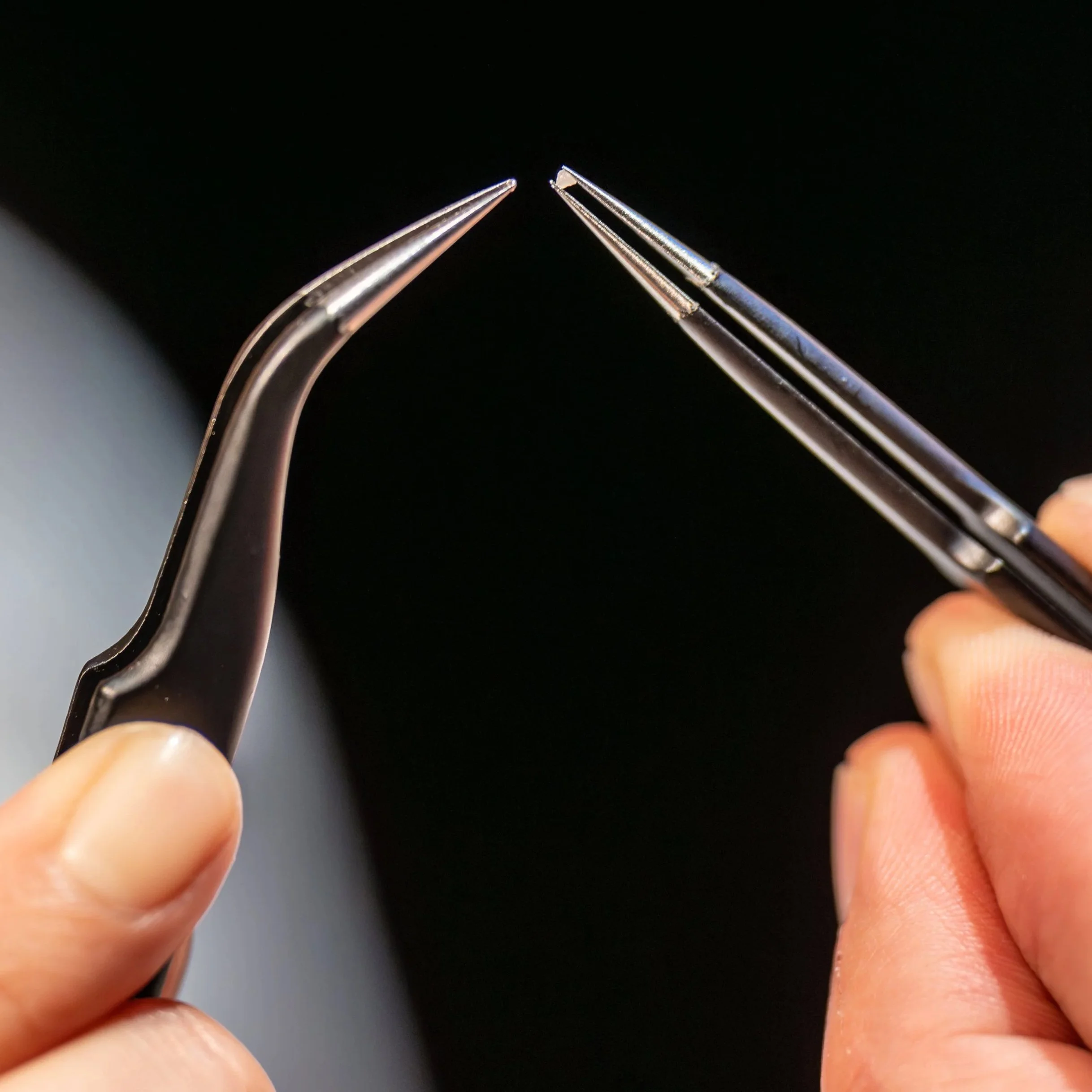
The biggest Puppets featured in Nano Steps were in fact visible to the human eye from up-close, and even puppeteerable with tweezers!
PHOTO BY Miika Storm
The Fear of Being Entangled
Like the technology-dependent sciences, us contemporary human subjects have found ourselves on the other side of the divide. Among the objects, or in a world altogether different. One in which the human should no longer possess the illusion of having the omnipotency to force an object-like world to their unbending will. Examples all too familiar could include the destructivity of authoritarian politics, despite being on the rise for years, or the undeniably advancing climate catastrophe. Paraphrasing philosopher Timothy Morton, the weather hasn’t been only weather for a long time. The surpassing of local high temperature records almost every July in the Northern Hemisphere has ceased being a signal of a pleasant summer day to spend on the beach. It may very well be a prelude to human extinction. (2013, 61-62) All this time, things and the environment have been wielding much more power than the Cartesially blind human has dared to admit. It would appear that we already live in an era where subject-object -thinking has become unsustainable.
Jane Bennett asks in her book Vibrant Matter (which we read in Finnish translation as Materian väre) how the political reactions to these urgent questions would change if we would take non-human entities seriously. She defines vitality as the ability to act as exemplified by storms, food products or metals. Each of them can change or reject plans made by humans. But importantly, they also have their own tendencies and orientations. Bennett suggests that the human relation to matter should be shifted from a vertical hierarchy to more of a horizontal and a parallel one (2020: 36). While building Nano Steps – a Particle Performance in the strict timetable of an institutional theatre, we initially tried very hard to accomplish absolute control over the particles, to be able to plan a certain script for the performance. A script that we could trust, so that every time we repeat the performance the scenes would work perfectly, and according to our predetermined human will. However, we constantly found ourselves powerless and unable to precisely dictate trajectories and narratives for our particles. So, instead of applying even more force to a contraption that simply would not collaborate with authority, we recognized the problem in our initial approach. In many of the scenes we tried to teach the particles circus tricks, until we realized our own relationship with the puppets to be horizontal instead of vertical.
If we redefine power or agency as an active participation in the common contraption, then the non-human entities must be allowed into a very close, a near-intimate, relationship with humans. Allowing the puppet and the contraption to take the reins of the action on stage, and rejecting the omnipotent power fantasies of the puppet master. Diving into such a togetherness is frightening. To be perfectly candid, we, as people grown up on enlightenment ideals, may have to admit that a portion of the thinking and being we considered our sole prerogative, actually occurs to a decisive extent elsewhere outside our central nervous systems and bodies.
Many times big realizations demand something else than a rethinking or a bold reconceptualisation. Sometimes just a bruise in one’s ego. To draw a historical parallel, before Copernicus introduced their sun-centred model for our solar system, people had an Earth centred understanding of the universe. The Copernican model that displaced humans from the literal centre of the universe claimed that the Earth is rotating the sun and not vice versa, and delivered a hard blow on human self-esteem. It caused an enormous uproar, and certainly one of the reasons was that it was building a new kind of scientific worldview, questioning the central importance of humans.
When facing topics or problems where the human comes face to face with the limits of their own senses and understanding, one easily feels very small. We have to admit that with our own bare eyes we cannot extend our perception to the beginning of time, into the core of an atom or to the distances of an unknown galaxy. When encountering the incomprehensible, something our mind cannot fully grasp, it is easy to feel overwhelmed by uncertainty. One can feel like a little stick in a stormy river; having lost the sense of control, it is easy to fear drowning into the all-pervading “contraptionality” of the contraption. Especially when we confess that humans have never had the exclusive right to determine the composition of their world or even their own destiny. But, through puppetry, Bennett and Barad we would like to ask: is that smallness really so terrible after all?
After having met a lot of people from the field of natural sciences, we have noted that there is one thing in common with many of the world's significant scientists. While they carry the experience and knowledge they have gathered over the course of their lives, as they age or as their understanding deepens, they do not lose their ability to direct their honest attention and curiosity toward new and challenging encounters. They do not lose the ability to let themselves be affected. It sounds simple, but we really think it is a rather patience-demanding, difficult, and sometimes even impossible task to hold firmly onto one's conceptions or knowledge without, however, shutting them tightly into a clenched fist. If one really wants to achieve deep understanding, one has to apply a light touch and reach out to the world with an open palm of sensitive curiosity. Like a puppeteer, with a touch honed on awareness and attention helping their puppet to perform. Simultaneously knowing that a grasp too tight destroys the magic, but the act of never touching, forsaking the hold also leaves the puppet not becoming puppeteered, and the co-formation of our world with its objects, subjects, performances, and performers slipping beneath the blurry horizon of unrealized possibilities.
About the Authors
Valtteri Alanen member of Trial & Theatre collective with an MA in Directing for Devised and Object Theatre in DAMU, Prague and a BA in Puppetry in Turku Arts Academy.
Iiris Syrjä, member of Trial & Theatre collective, is a dramaturg, writer and visual artist.
http://www.trialandtheatre.com/
Endnotes
1 Trial & Theatre. Nano Steps - a Particle Performance premiered in Helsinki City Theatre, Finland 2023 and Nano Steps – Into the Lab premiered in Alfred ve Dvoře, Czech Republic 2024.
2 We understand “actors” in the sense of actor-network theory, not necessarily human actors (though they could also be actors in the sense of ANT. For introduction to actor-network theory see for example Latour, Bruno, Reassembling the Social: An Introduction to Actor-Network-Theory (Oxford, 2005).
3 In this text we mean agents roughly in line with Actor-Network Theory: anything with agency in a given situation and/or relationship, not of the James Bond -type (even though the James Bond type agent may also be an agent in the sense of Actor-Network Theory!).
4 Physicist Artur Kopitca from Aalto University Finland gifted us the particular particle very well suited for the scene. We named the puppet “Arturs bead.”
5 Barad has served as a crucial source for contextualizing our thinking. These additional sources have also had a strong impact: Vibrant Matter – A Political Ecology of Things (2010) from Jane Bennett and History of Modern Science (2001) by Paolo Rossi. Also Ishmael Falke’s book Niin se vain on – Maailmankaikkeus nukketeatteriesityksenä (2021) After all – Everything is Puppetry (Soon to be published in English, 2026).
6 Professor Itai Cohen research group in Ithaca, Cornell University, Prof. Sami-Pekka Hirvonen and Gianni Vettese, University of Helsinki, Finland and Prof. Jaakko Timonen and his research group in Aalto University Applied Sciences, Finland, prof. Martin Ledinský and his team in FZU, especially Matéj Hývl, thank you for your hospitality! While writing the original version of this article, in Finnish, we had only had the opportunity to spend time in Cornell, hence the other research institutes feature less in the main body of this text.
7 Barad’s work has been first translated to Finnish by Annette Arlander: Barad, K. trans. Arlander, A. 2019. Posthumanistinen performatiivisuus – Kohti ymmärrystä siitä, miten materiaali merkityksellistyy, in the publication: Nauha, T. Annette, A,. Järvinen, H. ja Porkola, P. (editors). 2019. Performanssifilosofiaa: esitysten, esiintymisten ja performanssien filosofiasta performanssiajatteluun, Teatterikorkeakoulu, Taideyliopisto, Helsinki: Nivel 12, on internet: nivel.teak.fi/performanssifilosofiaa. Accessed 16.11.2022.
8 The hand of the puppeteer usually takes the place of internal organs in glove-puppets, for example!
Works Cited
Alanen, Valtteri. Silence and Other Impossible Objects. DAMU, 2022
Barad, Karen. Meeting the Universe Halfway: The Entanglement of Matter and Meaning. Duke University Press, 2007.
—“Posthumanistinen performatiivisuus – Kohti ymmärrystä siitä, miten materiaali merkityksellistyy.” Translated by Arlander, Annette. “Nivel 12 Performanssifilosofiaa: esitysten, esiintymisten ja performanssien filosofiasta performanssiajatteluun edited by Nauha, Tero. Annette, Annette,. Järvinen, Hanna. ja Porkola, Pilvi, 2019. (https://nivel.teak.fi/performanssifilosofiaa/posthumanistinen-performatiivisuus-kohti-ymmarrysta-siita-miten-materia-merkityksellistyy/ Accessed 16.11.2022).
Bennett, Jane. Materian väre. trans. Kilpeläinen, Tapani. Niin & Näin, 2020.
Bennett, Jane. Vibrant Matter: A Political Ecology of Things. Duke University Press, 2010.
Enqvist, Kari. Näkymätön todellisuus. WSOY, 1996.
Falke, Ishmael. After All – Everything is Puppetry. Grus Grus Teatteri, 2026.
—Keppi, porkkana ja musta laatikko. Sixfingers Theatre, 2011.
Kopitca, Artur. Manipulation and assembly of objects using spatially nonlinear stochastic force fields. Aalto University, 2025.
Latour, Bruno. Reassembling the Social: An Introduction to Actor-Network-Theory. Oxford University Press, 2005.
Morton, Timothy. Hyperobjects. Philosophy After the End of the World. University of Minnesota Press, 2013.
Popova, Maria. Figuring. Penguin Random House LLC, 2019.
Rossi, Paolo. The Birth of Modern Science (Making of Europe), Blackwell Publishers, 2001.