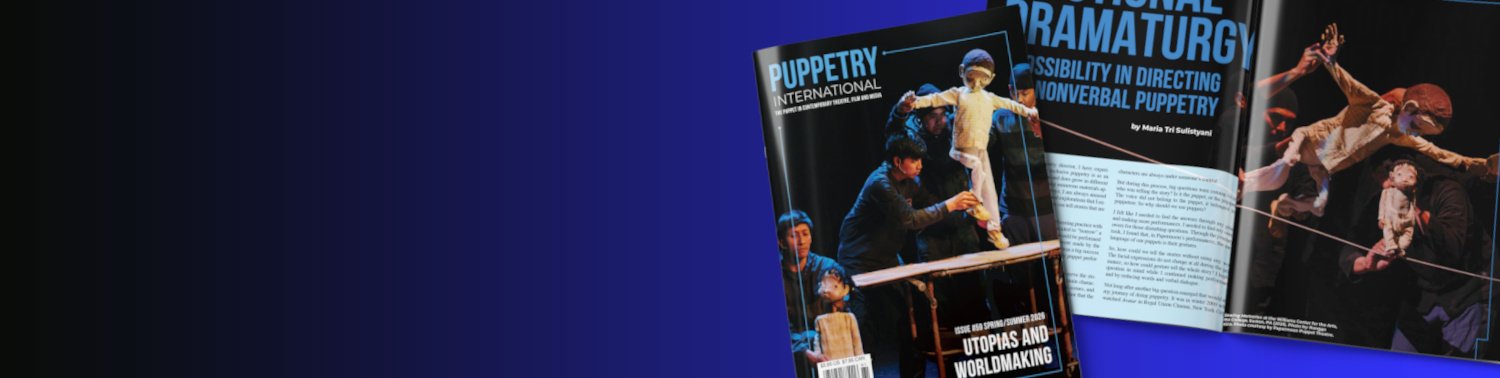
UTOPIAS AND WORLDMAKING
SPRING/SUMMER ISSUE NO. 59
Table of Contents • Editorial • Abstract
Worldmaking and the Politics of Scale
In a year marked by overlapping crises, this issue gathers carnivals, laboratories, shared spaces, and archives to ask how puppetry helps us imagine, contest, and inhabit different worlds—and who gets to do that imagining. The worlds collected here begin in the streets of Rio de Janeiro, spiral through grief, collaboration, and climate crisis, and end at the scale of nano-particles, revealing puppetry as a way of asking who gets to imagine, inhabit, and remake the world.
We open with Adriana Schneider Alcure’s article about Cordão do Boitatá, a carnaval that reorganizes Rio’s historic center through banners, a collectively animated fire snake, and a giant Pixinguinha puppet. Carnaval emerges as a system for disputing territory, reclaiming the city for Afro-diasporic communities, and weaving sacred and profane into a spiral time of ancestors and futures.
From there, we turn inward. In “Emotional Dramaturgy,” Maria Tri Sulistyani traces how Papermoon Puppet Theatre discovered its “mother language” in gesture rather than words, particularly in the PUNO cycle. Papermoon’s nonverbal work holds grief and loss in forms that invite audiences to plant their own stories onstage, suggesting that utopian imagination may begin with carefully shaped emotional journeys.
The first movement concludes in Bali, where I Made Sidia and Peter J. Wilson recount three decades of collaboration—from The Theft of Sita and Bali Agung to Varuna and ceremonial events. Grounded in Balinese cosmologies and global theatrical vocabularies, their partnership shows worldmaking as a practice of listening, care, and shared risk rather than quick fusion.
At mid-issue, climate crisis and displacement take focus. Carol Sterling’s dialogue with Neda Izadi and Jean Marie Keevins introduces You Have Arrived, a nonverbal pop-up performance about climate-induced exile for young audiences. Designed to be replicated rather than toured, it models a franchised structure of care and responsibility.
Ivan Tacey’s, John Kilburn’s, and Emily Tacey’s interview with artist activist Shaq Koyok continues this thread: giant cardboard and bamboo puppets—snakes, trucks, bulldozers, spirit beings—move from Orang Asli peatlands to shopping malls and COP summits as tools of Indigenous resistance. Collective puppet-making becomes an embodied refusal of erasure and a way to voice what cannot safely be said aloud.
The final section shifts scale. Victoria Ralston’s essay on the Scarey Ann doll line reexamines a small mechanical figure whose hair-raising mechanism and proliferating “family” of caricatures expose racial and gendered anxieties in 1920s American culture.
Toys, like puppets, rehearse social orders and fears under the guise of play, constructing worlds of otherness and belonging. Valtteri Alanen and Iiris Syrjä then take us into the physics lab, where microscopic particles manipulated by sound and electric fields become “the world’s smallest puppets.” Their performances merge lab and stage in a system where humans, instruments, and particles co-create, blurring puppeteer and puppet, subject and object. Ending here, the issue invites us to imagine utopias not as blueprints but as shared experiments with the materials and beings that move us.
Our recurring sections extend these concerns. “Who’s Who” profiles master puppeteer Bruce Cannon, with a Spanish version online. María Zurita Ontiveros’s peer-reviewed essay, edited by Dassia N. Posner, shows how Compañía Rosete Aranda imagined a Mexican national identity centered on working-class and Indigenous figures. A performance review looks at two productions from the OFF program at the World Puppetry Festival in Charleville-Mézières, while our book review addresses both volumes of The Puppet and Spirit. Together, these pieces remind us that worldmaking unfolds in archives, criticism, and biography as much as in parades, laboratories, and pop-up books.
— Alissa Mello