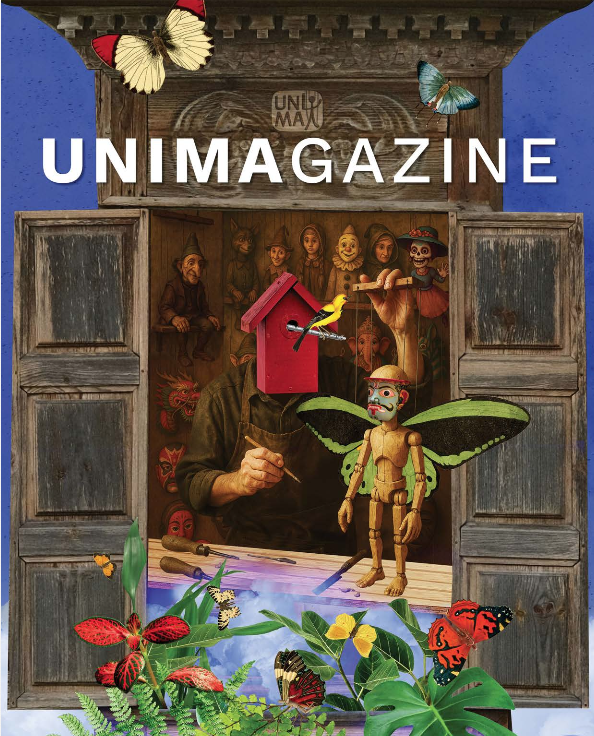

FLASHBACK: 1966
FALL/WINTER ISSUE NO. 60
Table of Contents • Editorial • Abstract
Sixty Years On
This issue of Puppetry International marks a double anniversary: it is the magazine’s
60th issue, coinciding with the 60th anniversary of UNIMA-USA. That convergence
prompted a deceptively simple question: what was happening in puppetry around
the world sixty years ago? The answers gathered here reveal 1966 as a period of
artistic invention, institution-building, international exchange, political repression, and
changing ideas about what puppetry could be. Together, they show that a flashback
is never merely backward-looking: it brings us to the institutions, artistic languages,
political wounds, and historical categories that continue to shape puppetry now.
We begin with Nancy Staub’s personal recollection of the 1966 Puppeteers of America
Festival in San Diego, where Mollie Falkenstein called a meeting to form an American
Center of UNIMA. Her reflections offer both a founding memory and a reminder
that organizations are sustained by relationships as much as by records. Kathy Foley
then turns to Indonesia, where the violence of 1965–66 affected puppeteers as well
as countless other citizens. Through the experience of dalang Ki Tristuti Rachmadi,
imprisoned for fourteen years, and Papermoon Puppet Theatre’s later work Mwathirika,
Foley considers puppetry as a means of holding memory, confronting political silence,
and imagining reconciliation.
Kathleen Doyle’s article on Vietnamese water puppetry considers another Southeast
Asian theatre form shaped by war and cultural policy, following it from rural ponds
and closely guarded guild knowledge to cultural-preservation programs. Her account
attends to its material and sonic life: murky waters, music, and scenes of rice planting,
buffaloes, fish, and collective labor. From there, Evelyne Lecucq examines Alain
Recoing and Maryse Le Bris’s 1964–66 work on The Snow Queen, in which the
puppet stage itself could become a “hyper-puppet”: an expressive body shaped through
structure, scale, lightness, and the careful manipulation of materials.
Octavian Szalad traces Romanian puppet theatre’s development and international
visibility in the mid-1960s, from Țăndărică Theatre to the 1965 International
Puppet Theatre Festival in Bucharest. His article shows how institutional networks
and international encounters supported the period’s achievements, even within the
constraints of communist rule. Finally, Nazlı M. Ümit considers how the 1960s shaped
the categories through which puppetry is still understood. Her study of Metin And and
Karagöz examines how “traditional theater” helped secure recognition for Karagöz
while too often treating it as fixed heritage rather than a living, continually adapting
performance practice.
Our recurring sections extend these conversations across other moments in puppetry
history. In “Who’s Who,” we celebrate Paul Vincent Davis, whose long career began
in 1965, and we relaunch John Bell’s History Column. Its inaugural article reflects
on wayang in the 1920s through a 1927 exhibition of puppets from the William Ross
Matson collection, now held in the Ballard Museum archive, and through the string-
marionette work of Lenny Suib.
This issue’s reviews span forms, places, and generations: a performance review of
The Cycle of Gangho by Jin Kwei Lo Puppetry Company; a report on the Pilsen
festival in Czechoslovakia; and a review of the Phoenix Art Museum’s 2025 Arizona
Artist Award, which premiered on 29 July 2026. Together, these features affirm that
puppetry’s history is not confined to anniversaries or archives. It remains active in the
work artists make, the collections we revisit, and the performances that continue to
change how we see the field.
— Alissa Mello